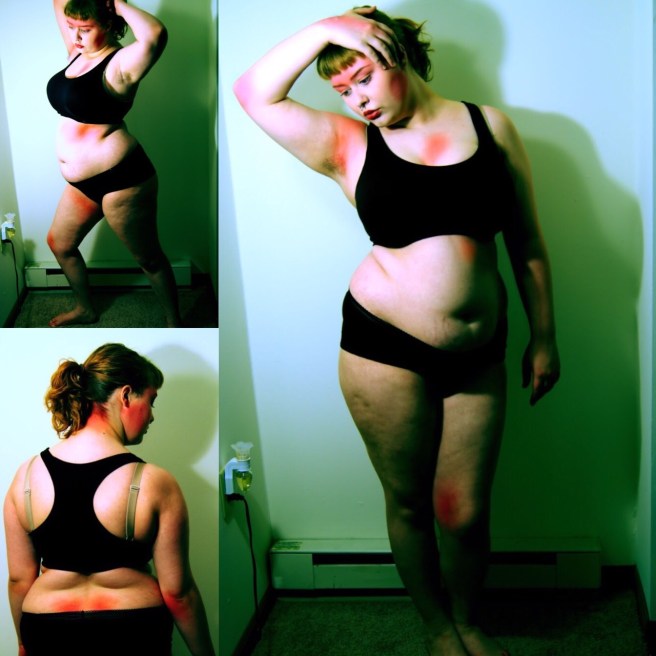
This is going to be a very vulnerable post for me, and not because I’m half naked and showing my face. This is the beginning of a photography series involving chronic illness.
In December of 2015 I was diagnosed with a genetic disorder called Ehlers Danlos Syndrome after a lifetime of health problems that never seemed connected. EDS is a collagen error in my genes meaning my collagen doesn’t form the way it’s meant to. Since collagen is the glue of the body, this means that almost everything can be affected. From Wikipedia, “Collagen provides structure and strength to connective tissue. A defect in collagen can weaken connective tissue in the skin, bones, blood vessels, and organs, resulting in the features of the disorder.” People with EDS often have chronic pain in their joints due to loose ligaments and weak muscles allowing those joints to frequently dislocate. Muscle spasms and nerve pain are also common. The pain involved with EDS is what this set of photos focuses on.
I experience chronic pain every day. I tend to keep it hidden because continually complaining about my pain will only make it harder to handle. It’s not something you can see so I know people, aka my family, have a hard time believing that it’s actually happening, especially when I push through my pain with a smile.
This set of photos is meant to help people visualize the pain I experience that they don’t get to see. It’s meant to bring an understanding that you can never know what someone may be experiencing that you can’t see.
The pink/red spots highlighted on my body are places where I experience pain regularly, most often all at the same time.
(Okay to reblog, please don’t remove the caption, 100% NOT for blogs with raunchy porn or fat fetish/feeder blogs)
thank you for sharing this. you’re brave and beautiful.
having an invisible disability is so frustrating. it’s easy to get mad at the people around me for inadvertently making my life harder, but even when they know intellectually that i have these problems – and even specifically what the problems are – they can’t SEE when i’m having a rough day, they can’t SEE when i’m having a flare-up. some days, if there’s an empty 12-pack box on the kitchen floor, i can easily pick it up and take it out to the recycling bin; some days, i can’t even step over it, and just nudging it aside with my foot makes me wince. it’s not my friends’ and family’s fault they don’t know when i’m hurting. i don’t want to guilt people for that. what i do want them to understand is that the fact my illness is invisible makes it even suckier.
i’ve taken to using my cane in public even when i’m not having a bad mobility day, because people see it and are a little bit more careful around me, so they’re less likely to do something that will give me a bad day. OP, if you don’t use a cane, you might consider starting, even if balance while walking isn’t an issue for you; people bump into you on the sidewalk a whole lot less, and don’t let their dogs jump on you. 😀
Because you can never have enough guides to Disability Etiquette …
I’ve been wanting to write a post about “disability etiquette” for quite awhile. Mainly, I want to try to come up with a simple set of guidelines that covers the essentials of what we consider “disability etiquette.” First, I think we have to be clear about what “disability etiquette” is for.
Is it meant to make social interactions less annoying and humiliating for disabled people, so our everyday lives suck a little less? Or, is it designed to make non-disabled people feel more confident interacting with disabled people, so they will interact with us instead of shying away?
Obviously, it’s a little of both, and I don’t think the two goals necessarily conflict. With both in mind, let’s take a shot at a three-point guide, structured by three very basic questions I think non-disabled have about us, and that we have about how we actually want social interactions to go:
Question 1:
Is it okay to ask a disabled person about their disability?
Answer:
It depends on the situation and how well you know the disabled person. If you’re a stranger or an occasional acquaintance, it’s hard to justify asking a disabled person about the specifics of his or her disability. Even if you know them pretty well, if you’re talking about work, or your last vacation, then it’s probably awkward and inappropriate to suddenly say, “You know, I’ve always wondered, what is your disability actually called?” On the other hand, if you are a wheelchair user and you’re in an emergency room because you’re violently ill, it’s probably okay for your nurse to ask for some details, even if he or she is a complete stranger.
If you’re not sure whether you know someone well enough to ask, think of an analogy. In a similar situation and level of acquaintance, would you ask whether a person is married or has kids? Would you dig further and ask if they are divorced or widowed? The better you already know and trust someone … and the better they know and trust you … the more it’s potentially okay to ask about a person’s own disability.
Above all, think about why you want to ask. Is there a truly practical need to know? Do you really care about the person, and want to know them better as a person? Or, is it insatiable curiosity, like an itch you’re just dying to scratch? If your motivation is more like the latter, it’s a good sign you should probably leave it alone.
What’s it all about? Appropriateness.
Question 2:
Is it okay to ask if a disabled person needs some help?
Answer:
Asking is the key. It’s almost always good to ask. The problems arise when people dive in to help without asking, or when they ask, but then don’t listen or overrule the answer.
If you ask a disabled person if they need help getting into or out of a building, and the answer is, “Yes!”, ask how you can help, and do what you can realistically do to help, according to the disabled person’s instructions. If the answer is, “No thank you,” or even “NO! Go away!”, respect the answer, and don’t take it personally. That can be hard to do if you’ve just been snapped at. But, if you’re original motivation was really to help, then it shouldn’t matter if the answer you got was politely given or incredibly rude. If you find yourself feeling personally offended, ask yourself whether your real priority was making the other person’s day a little easier, or was your actual goal to feel a little better about yourself. There’s nothing wrong with boosting your ego a little by helping others, but things start to get out of balance when that’s why you offer people help.
Of course, if the disabled person takes you up on your offer, first ask how you can help and then follow the disabled person’s instructions. Don’t take “Yes, thanks” as your cue to take charge of the situation. That is exactly the sort of thing that causes many of us to resist help, especially from strangers, even when we probably really do need it. Also, following instructions is critical, even if you’re sure you know what you’re doing. The disabled person usually knows much better than you do how you can help them, and may also be more aware of the safest ways to do things for both of you.
What’s it all about? Control.
Question 3:
For real now, no messing around … which term should I use? Disabled Person? Person with a Disability? Physically Challenged? Special Needs?
Answer:
This one can frustrating, for sure. It seems like we are always changing our minds and can never agree even among ourselves which terms to use and encourage others to use. Given that reality, your best bet is to take a two step approach to terminology.
Start out using “disability” and “disabled” as your default terms. A lot of disabled people still don’t like “disabled” and “disability,” but it does seem to be the most universally understood and accepted term, applicable to all kinds of disabilities and across all cultures. Whether it makes complete sense to your way of thinking at the moment, it is the most widely accepted way of referring to physical or mental impairments.
If those words are accepted with no comment, you’re fine. If a disabled person objects though, and says they prefer other terms, then respect their preference, whatever it might be.
It’s worth noting that there is currently a debate going on inside the disability community between person-first language … where you say “person with a disability,” and identity first language … where you say “disabled person” or just “disabled.” If you’re not disabled yourself, you really don’t need to worry about this. Just go with what the disabled person or people you are with seem to like better.
Above all, never lecture to a disabled person on why your preferred terms are correct, and the terms they prefer is wrong or misinformed. You might know something deeper and more significant about disability than a person who actually lives with disabilities everyday, but it’s unlikely. In any case, telling a disabled person that they’re doing disability wrong is just obnoxious. Don’t do it.
What’s it all about? Respect.
Is there more to “disability etiquette” than these three things … Appropriateness, Control, and Respect? I’m not sure there is.
You can spend minutes, hours, days, weeks, or even months over-analyzing a situation; trying to put the pieces together, justifying what could’ve, would’ve happened… or you can just leave the pieces on the floor and move on.
Stimming is shorthand for self-stimulatory behavior. Stimming is often repetitive movements that seem purposeless on the outside, but it’s actually serving a very important purpose: regulating our nervous systems! 😀
I stim to create sensation when I feel understimulated, I stim to shut out other stimuli if I’m overstimulated, I stim to help me focus on something, I stim to express myself and sometimes I stim just for the heck of it. Sometimes I start stimming without realizing it and become conscious of myself doing it(semi-voluntary) and sometimes I choose to start doing it(voluntary).
Like right now, I just now realized I’m bouncing my leg like a jackhammer. I don’t remember starting to do it. Then I rocked backwards and forwards twice while waving my arms in the air– I chose to do that.
You might be stimming a lot and not realize it. Any action that’s repetitive can be a stim. Leg jiggling, twirling a pen, tapping your fingers, chewing the erasers off your pencils, looking at things that sparkle or are colorful, rubbing velvet or stucco, sniffing bottles of lotion, sucking on lemon slices, making random noises, listening to music or repeating the same song over and over are all forms of stimming. The list is honestly endless.
This is happy stimming mixed in with sensory seeking stimming. Trust me, you will see the happy stims because the rhythm and “size” of my happy stim movements are different than sensory seeking stim movements:
And here’s a video of visual stimming from my perspective. I like sparkly things and how moving them can make points of light appear to flow like water. Sometimes I look at it with my eyes unfocused and my imagination goes wild.
(* * * Warning: Video may induce sensory overload if you have issues with sparkle, flicker or shifting light patterns.* * *)




















 Holding the Bowl