

I always hate it when people are all “so do you go to school, or are
you working, or” and I either have to
- make up some lie, or
- eventually get
around to “I am not working because of depression/anxiety,” and
subsequently have to deal with whatever bullshit-riddled and completely
unsolicited opinions on mental illness this stranger feels obligated to
share with me.So my therapist was like, “You don’t have to do either.
You can just say you haven’t worked in a while because you’re recovering
from an illness.”I tried it when the home inspector was here today, and it fucking worked.
He was like, “oh, I’m sorry, are you doing better now,” and I’m like
yeah, and don’t worry, it’s not contagious, awkward laugh, and we moved
on.MY THERAPIST. IS A GENIUS. Because it is an
illness, so it’s not a lie to say that, and it’s also none of his
business to know specifically what it is, and I clearly don’t want to
give more details, so we should move on from this topic. MY THERAPIST IS A GODDAMN GENIUS.Dude I needed this. I never know what to say when people ask if I work because I’m severely disabled and don’t work.
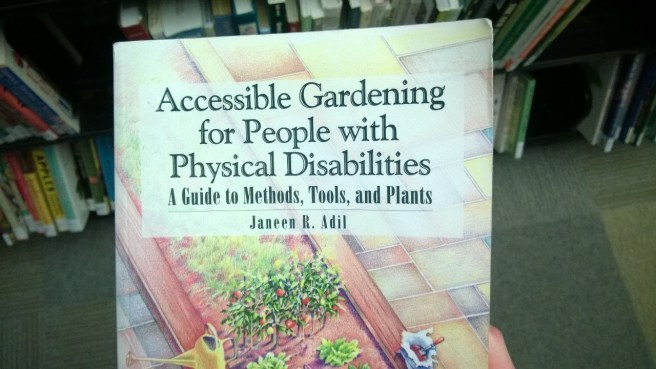
this book is worth more than a dozen restaurants that grow their own microgreens on the roof
😍
I know this isn’t a gardening blog, but I feel like this would come in handy for those of you who want to grow your own food!
– Mod Aya
Practical Tips, From Experience
If you’re in a down patch, and you’re able to find this, I’ve compiled a list of handy things that have helped me survive the horrible pits of despair with relative ease.
Food
– Stock up on ‘easy’ foods. Canned goods, soups, TV dinners, or other things you can just throw in the oven. It’s absolutely essential that you can still eat, regardless of what you’re putting in your body. You can work on the ‘better’ diet once you’re mentally stable.
– If you’re having trouble with solids because your depression forces you to stop eating, definitely make use of the soups. Broths, especially, can get some nutrients into you without making your stomach feel like it needs to purge.
– If you’re worried about a nutritional deficit, stock up on meal replacement powders or shakes. My go-to is Usana’s Nutrimeal/MySmartShake, that I get from my friend Stacey. They’re filling but not overbearing on the stomach, so when I forget to eat, or stop eating entirely, I’m never worried I’ll be malnourished.
– Have 2-3 blender-style bottles handy, so that making shakes is as seamless as possible.
– If you binge during your low periods, try and keep your water intake as high as possible. That should help force your stomach to shush for a while, and if drinking liquids doesn’t help, I find bananas to be a wonderful source of filling snackery, as well as granola bars. You can also try replacing a drink or two each day with a meal replacement shake, which can help fill the gap and prevent over-eating.
– Tea. Tea tea tea. It doesn’t really matter what kind of tea it is, as long as you find it tasty. There’s something about a warm cup of tea, prepared to perfection, that can at least temporarily get me out of a slump. Herbal infusions, green teas, and white teas are probably ideal, because of the high antioxidant properties and smaller caffeine influence.Daily Structure
– One of the things that destroys me during my down periods is the drop in routine. Keeping a routine is critical for mental stability, because it can prevent rumination and intrusive thoughts.
– No matter how late you wake up, change your clothes. It is so tempting to stay in bed in your PJs all day, but the simple act of changing into a new set of clothes can help wake you up, and assist in basic functions and self-care.
– Spend 10 minutes cleaning. Doesn’t matter what, where, or how you clean, but even something like washing a few plates in the sink has kept me sane and alert. Do something you’ll reasonably enjoy, since that’ll help give your brain the feeling of fulfilment much easier.
– Set alarms. Depression can nuke your sleep schedule something fierce, so having at least two alarms can help remind you when to wake up and go to bed.
– Speaking of bed, find ways to wind yourself down. Read a book, play a casual game on your phone/tablet, do something with your hands if you like (knitting, crochet, sew, Lego, puzzles, etc.) As long as you make sure you’re relaxed and engaged in what you’re doing, you should be able to wind down. I have a side lit e-reader that I use to get me sleepy once I lay down.
– Talk to someone at least once, if you can. If all your friends are busy, download or navigate to 7 Cups of Tea. It’s an app that will connect you to a Listener, and it’s 100% Free. They also have daily progress paths, mental health exercises, and affirmations that can help remind you that you’re valuable.Misc.
– TAKE YOUR MEDS. Set alarms if you have to. Do everything you can to preserve your medication regimen, because if you have meds, keeping that routine stable will help you come back faster.
– Keep tabs on your appointments. When I’m lost in a downward spiral, I will forget literally everything I’m supposed to do. It’s terrible. I’ve started putting my appointments in my phone to make sure I keep them within arm’s reach, and always visible using the widget.
– Stimming/Force Focus. If I’m caught in a panic, I find something soothing to the senses. Fuzzy blanket, cat, dog, plush turtle to snuggle, Lego pieces to fidget with or build to keep my hands busy. Finding something that draws focus is critical for avoiding intrusive thoughts and excessive rumination. I do connect the dot puzzles because they rely on sequential number patterns, and I usually feel better after a small burst of it.
– Keep your support network involved, as best you can. Never feel stupid for reaching out to loved ones when you’re down. If they don’t know you’re hurting, they can’t help you heal. And if it’s not a good time for someone, they’ll tell you. Do not feel like you’re bothering them. If you’re worried about one person being unavailable, send a message to two or three people just to make sure you’ve got backup.I’m running out of ideas right now, but hopefully these are a good start. Feel better, friends. ❤
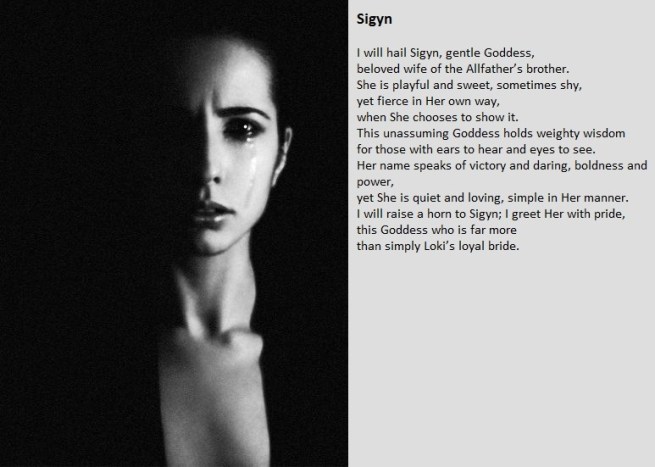
- Frigg and Sigyn sitting down around the hearth fire to crochet and gossip
- Sol and Idunn giggling in the kitchen baking apple pies decorated with pie crust suns
- Freyja and Mordgud working out at the gym together as gal pals do
- Sif and Sigyn trading parenting tips over coffee at the local coffee shop
- Mordgud dragging Hel to go see the latest nerdy movie trending for an all female cast
- Hel and Eir gently comforting Sigyn when time catches up with her and memories weigh her down
- Eir making hot tea for all the goddesses for the weekly book club meeting
- Frigg redecorating the homes of the other goddesses whenever the mood strikes and they’re willing
- Sol and Jord out in the kitchen garden, tending to the herbs and poisons, as they are apt to do
- Jord and Mordgud walking late into the twilight just to watch the stars come out and the sky to dance
just goddesses without boundaries doing what they do
In light of everything going on…
Could people, anyone capable of doing so, please do something every single time you see someone describe ableism as being about a list of words you are supposed to say and a list of words you’re not supposed to say?
Ableism is about going to a hospital and getting told by doctors that you’d be better off going home and dying than getting a feeding tube.
Ableism is about going to get SSI and getting told that if you can blog (or do some other random thing that is not gainful employment and will never be), you can work for gainful employment.
Ableism is about your own family believing you’re lazy or exaggerating or faking because you don’t seem like their idea of what a disabled person is (young white guy in a wheelchair from paraplegia, usually – who are actually usually among the more privileged and able to work of disabled people, not that they have it easy by any means, especially since able to work doesn’t mean able to get hired in an ableist workforce).
Ableism is about valuing people based on what we can do, rather than valuing people because we exist.
Ableism is about drawing a line past which people don’t count as disabled anymore, they just count as not even people, and not worth protecting.
Ableism is about there being entire books where people think it’s legitimate to debate whether people with intellectual or other cognitive or developmental disabilities (those are three totally different but overlapping categories, just so you’re aware) count as persons or not. Both “philosophically” and under law. Google Peter Singer if you don’t believe me (he also doesn’t think newborns are persons, but everyone loves him because he supports animal rights – by bringing down disabled human beings in the process, and everyone knows – because of ableism, of course – that disabled human beings don’t matter anyway, not as much as animals).
Ableism is not – at least not mostly – about whether ‘stupid’ is a slur. It’s just not. And it infuriates me both when disabled people treat it primarily that way, and when nondisabled people treat it primarily that way.
Because when you do a serious discussion of racism, and then classism, and then sexism, and transphobia, and transmisogyny, and homophobia, and biphobia, and every other kind of oppression you can think of, large and small, and you give them in-depth coverage… and then you come to ableism. And it’s always last. And it’s always a footnote to all the other kinds of oppression. And the footnote always reads “And ableism… don’t say stupid, or idiot, instead, say these other words that don’t actually form an adequate replacement for those first words at all.”
Which diminishes the understanding of the power of actual ableist slurs such as retard (hint: a slur carries with it as part of the meaning, that the person being described by the slur is not a real person – an insult like ‘stupid’ can be used in an ableist or non-ableist way but is not necessarily a slur even when it’s ableist). And it also diminishes the understanding of what ableism actually is, by not taking seriously the fact that ableism kills people.
And even this act of always putting ableism last, always treating it as less serious or possibly not even a real ism at all (possibly “political correctness gone amok”, possibly “(eyeroll) yet another group of people wanting to claim they’re oppressed and really stealing the idea of oppression from real oppressed people like people of color and taking their ideas and successes without crediting them at all”, however it’s phrased… that is one of the worst things about ableism in circles that claim to want to deal with oppression in all its forms. Because it basically throws us to the wolves while claiming there are no wolves to throw us to and that we aren’t really dying in huge numbers everywhere and so forth. There are ways in which ableism becomes worse, more deadly, because of being diminished in this way by all the “serious” anti-oppression people.
So – I don’t care if you call what you do social justice or anti-oppression or anything else. I don’t care if you’re part of those circles or not. I don’t care if you use ideas from those circles or not. I just don’t care. All I care about is that you take ableism seriously and that you take the danger disabled people are in right now seriously and part of taking it seriously is making sure that people understand it’s not about what words are politically correct or politically incorrect at this particular moment in time when it comes to disability.
Because disabled people are often the first to die – or among the first – in situations like this. And this is not an accident. It is because the people with power know that a lot of people don’t give a rat’s ass what happens to us, whether on the right or on the left. It’s because they know that you don’t take our oppression seriously. It’s because they know that our deaths will be considered inevitable. Have you ever considered it inevitable that disabled people and old people end up in nursing homes, group homes, developmental centers, psych wards, and other institutional settings? – sad, maybe, tragic even, but inevitable consequences of disability? Because that’s the same kind of thinking that makes our deaths inevitable. (By the way, nursing homes are the cause of death for a lot of us, but our disability gets blamed instead and this is all normalized so much you probably can’t even see it.) Have you ever considered it inevitable that disabled people contemplate suicide, and never thought it might be the result of the same forces that cause other oppressed people to contemplate suicide? Have you ever responded almost reflexively to disabled people’s suicidal thoughts by saying that we ought to have the right to kill ourselves easily and painlessly (when you’d never say the same of, say, queer teenagers), without even thinking that maybe most of the time we’re suicidal for the same reason queer teenagers often are? Have you ever thought that when we don’t get SSI and die on the streets, that’s just…. unfortunate but sort of inevitable? That basically our deaths however and whenever they happen are unfortunate but inevitable consequences of being disabled, and you’ve never even thought of the way ableism plays both into our deaths themselves and into your own thoughts about them?
Because that’s why you need to get people to take ableism seriously immediately. And that’s why I’ve always been infuriated by people not taking ableism seriously. Because I’ve been that person in that hospital room being told by doctors that I would do better off to go home and die of a totally preventable pneumonia or starvation, rather than get the combination of feeding tubes that would prevent both?
Oh and by the way – don’t quote me statistics about aspiration pneumonia and feeding tubes unless you know my exact disability, the exact cause of the aspiration pneumonia, and the exact configuration and type of feeding tubes I use and exactly how I use them. I know that as a general rule feeding tubes don’t prevent aspiration and may even cause it, but in my particular circumstances that doesn’t apply. There are dozens of reasons for feeding tubes, dozens of types of feeding tubes, and if you don’t understand all of this in-depth you have no basis for commenting. I went from getting aspiration pneumonia seven times in the first few months of a year, to getting it once or twice a year at most, instantly, with the right combination of feeding tubes. And I gained back roughly half of the 75 pounds I’d lost rapidly as a result of my stomach disorder.
And I’m happy, and I’m fucking alive, which is more than I expected by now. I didn’t expect to hit 34 or 35, and I’m now 36. I might even eventually hit old age at this point, who knows. But however long I lived, I deserved a chance to be alive. And it took a lot of people calling the hospital and demanding I get treated right, to even get the feeding tube. They couldn’t deny it to me – because I needed it – so they just tried every trick they knew to talk me out of agreeing to it. After tumblr and other places resulted in enough phone calls to the hospital, I got my tube the next day, although my problems with ableism in that hospital were and remain far from over and the circumstances of getting the tube and the aftermath were something out of a nightmare scenario. Not because they had to be, but because they could get away with it, because ableism is everywhere and practically unacknowledged by just about everyone, including especially the people who supposedly care the most about disabled people (family, caregivers, “helping professionals”, anti-oppression people, etc).
Anyway, this has gotten into a long enough rant I’ll be surprised if you could read this far – I probably couldn’t (I write better than I read). But hopefully you get the message. Right now is a time when disabled Americans, especially those of us facing other forms of oppression (ever try to get proper medical care as a queer, genderless and visibly gender-atypical, poor person with developmental disabilities? …yeah) need people fighting ableism more than ever. And that doesn’t mean tacking up a list of words that everyone can say instead of ‘stupid’. And treating it like it does, is part of the problem that leads to us dying in circumstances like these.












 Holding the Bowl