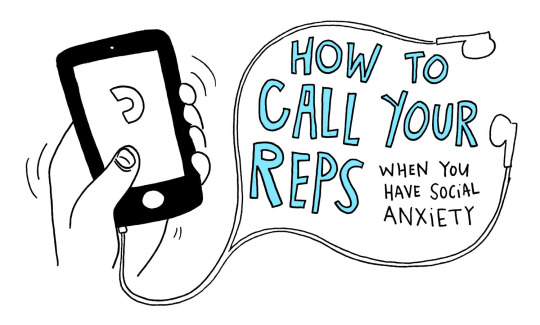
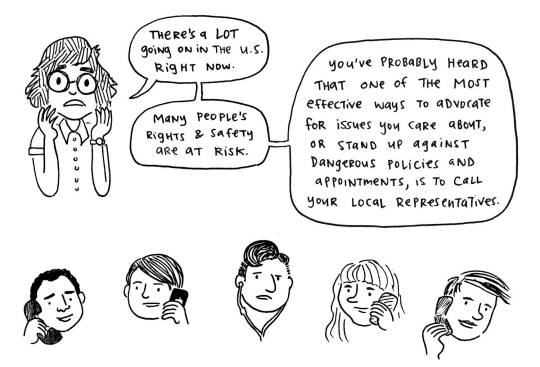
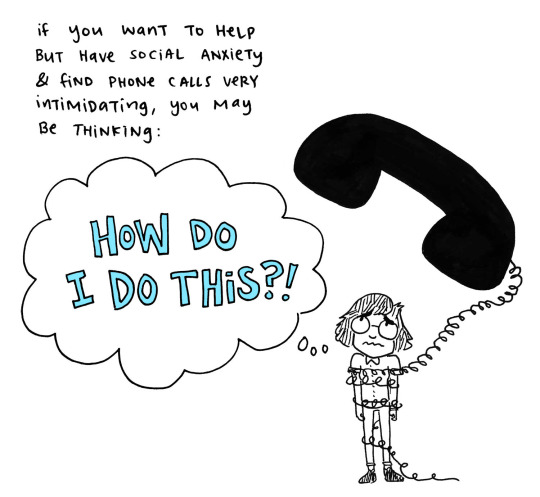
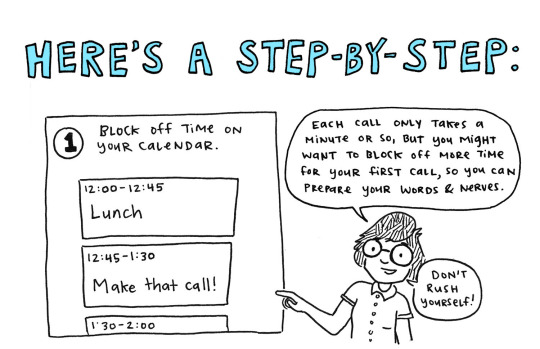
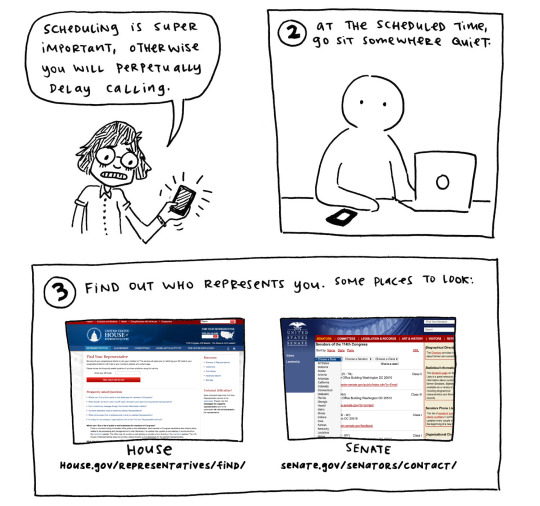
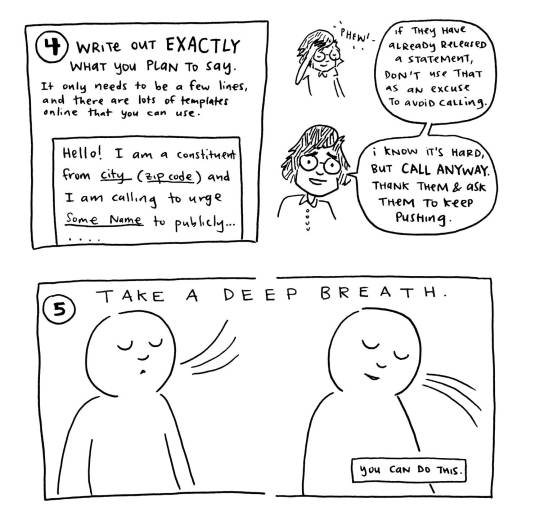
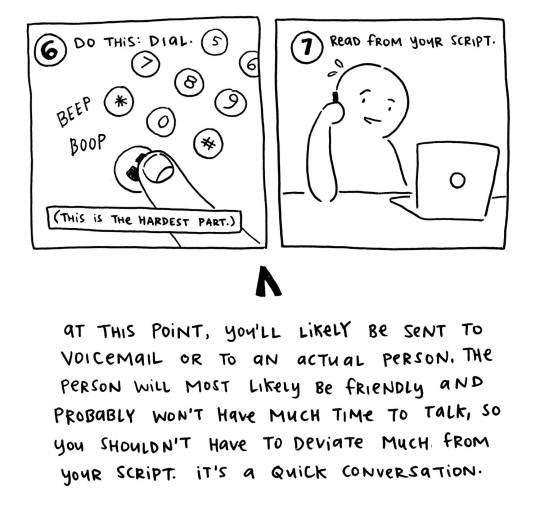
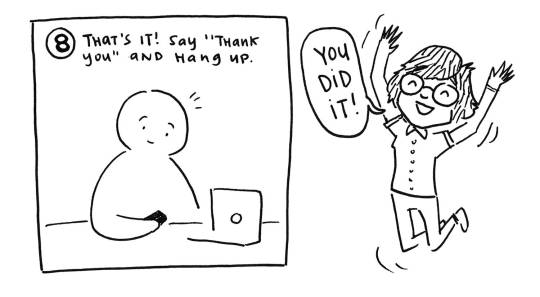
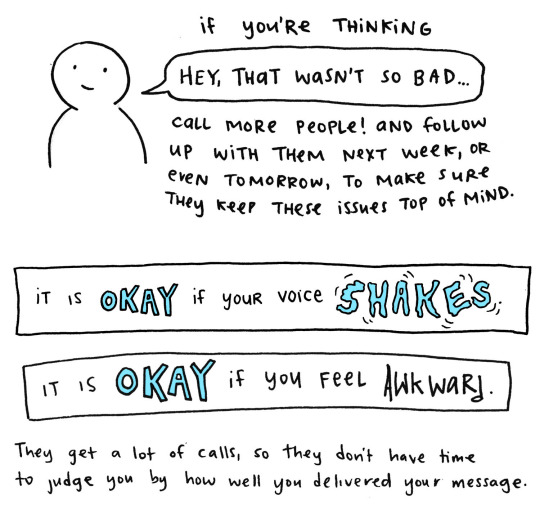
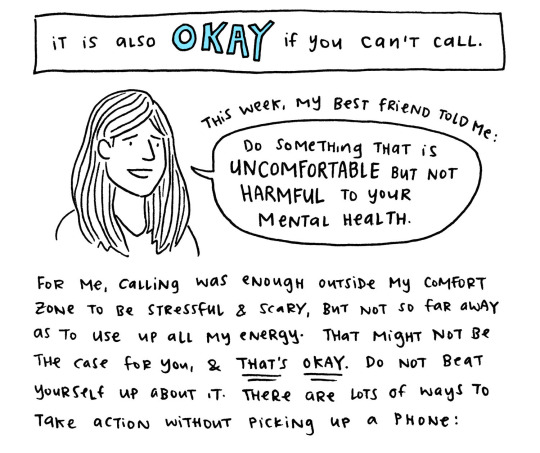
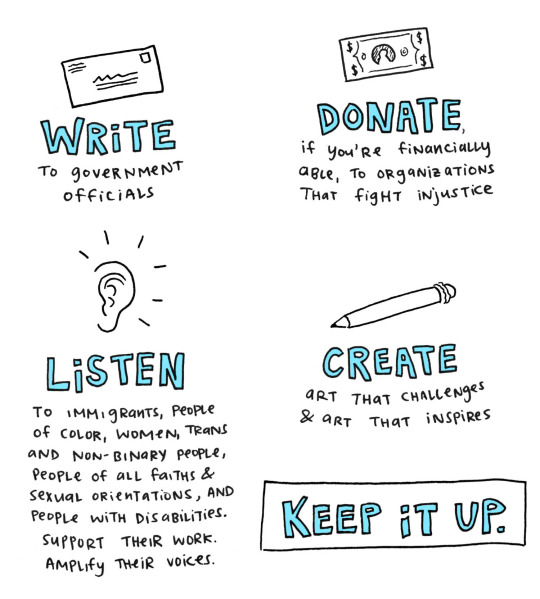
When you struggle with your mental health on a daily basis, it can be hard to take action on the things that matter most to you. The mental barriers anxiety creates often appear insurmountable. But sometimes, when you really need to, you can break those barriers down. This week, with encouragement from some great people on the internet, I pushed against my anxiety and made some calls to members of our government. Here’s a comic about how you can do that, too. (Resources and transcript below.)
Motivational resources: There are a lot! Here are a few I really like:
Sharon Wong posted a great series of tweets that helped me manage my phone anxiety and make some calls.
Kelsey is tweeting pretty much daily with advice and reminders about calling representatives. I found this tweet an especially great reminder that calls aren’t nearly as big a deal as anxiety makes them out to be.
Informational resources: There are a lot of these, as well! These three are good places to start:
Children with autism
may benefit from fecal transplants – a method of introducing donated
healthy microbes into people with gastrointestinal disease to rebalance
the gut, a new study has found.
Behavioral symptoms of autism and gastrointestinal distress often go
hand-in-hand, and both improved when a small group of children with the
disorder underwent fecal transplant and subsequent treatment.
In the study of 18 children with autism and moderate to severe
gastrointestinal problems, parents and doctors said they saw positive
changes that lasted at least eight weeks after the treatment. Children
without autism were included for comparison of bacterial and viral gut
composition prior to the study.
“Transplants are working for people with other gastrointestinal
problems. And, with autism, gastrointestinal symptoms are often severe,
so we thought this could be potentially valuable,” said Ann Gregory, one
of the study’s lead authors and a microbiology graduate student at The
Ohio State University.
“Following treatment, we found a positive change in GI symptoms and neurological symptoms overall,” she said.
The study, which appears in the journal Microbiome, was
conducted while Gregory and her adviser and co-author, Matthew Sullivan,
were at the University of Arizona. Other lead researchers on the
project are from Arizona State University and Northern Arizona
University.
The study will appear in Microbiome during the week of January 23, 2017.
The reason “problem” behaviors lessened or stopped is the autistic people weren’t experiencing tummy discomfort. A gassy, upset or crampy stomach can make it hard to tolerate other stimuli.
Imagine having a fan in your room that’s really loud and grating, but you have to deal with it because you can’t afford a new one. You have to blast your TV to hear it, you plug your free ear while talking on the phone and it’s hard to get the little nuances of music with the constant buzzing or droning noises in the background.
Then one day your friend comes over and takes the fan apart, cleans all the moving parts, oils them up and puts it back together. No more grating noise, it’s just a quiet hum again.
You can listen to your TV at a comfortable volume again. You can relax while on the phone. You can study all the little nuances in the music you listen to. No more distracting “background process” is vying for your attention.
That’s what resolving gut problems does for autistic people.
Grieving the time you loose because of mental illness is one of the hardest things. Sometimes it’s weeks and a few friends, then sometime it’s months and the special occasions missed and more friends drift away.
When it gets into multiple years its no longer about the friends you once had, or the family you were once apart off, it’s just the time. The person you could have been, the people you could have meet, the fun you never had the photos that where never taken. Years stripped from your youth, with no great brave story to say for.
People don’t want to hear about the years you “bravely” fought mental illness. Mental illness is so personal that people don’t know how to talk about or what to think of it. It’s too deep, too heavy. It’s not surface stuff.
Be shining like Freyja, but know to put yourself first above all others.
Be humble like Iðunn, but know that you hold powers unimaginable that even they don’t see.
Be careful and shrewd like Frigg, but know when to cherish what you have before it’s gone.
Be wild and free like Skaði, but know that there is no shame in longing for what is home.
Be strong in your convictions like Hel, but know when to have your heart turn toward a worthy cause.
Be enchanting like Gerðr, but know that your radiance is something they can never take from you.
Be a comforting pillar like Sif, but know that it is alright to ask for a helping hand in return.
Be clever like Loki, but know that not everyone can distinguish between cunning and harmful trickery.
Be righteous like Njörðr, but do not bend others to your will and mind like a tyrant.
Be proud of achievements like Bragi, but do not forget the many hands that go into one great piece of work, and dole out thanks accordingly.
Be tender and loving like Freyr, but don’t forget how to fight for your survival with tooth and nail.
Be forever fighting for your loved ones like Týr, but be weary of those who would call you friend and kin only to feed you to the wolves.
Be full of grace and charm like Baldr, but know that not every battle can be fought with the power of soft speech and courtesy when life is on the line.
Be a lover of justice like Forseti, but know that not everyone is looking for advice to their ills.
Be ever keen of eye like Heimdallr, but know that not all secrets that your gaze sees should be shared in others company.
Be blameless like Höðr, but know that even then, all our hands will be stained blood red with some lie or deed eventually.
Be willing to stand tall by your own merits like Ullr, but do not shy from friendly hands that would see you whole and hale to the end.
Be ferocious and strong like Þórr, but know when to stay hand upon weapon and offer kind word instead.
Be a searcher of knowledge like
Óðinn, but be mindful that while we cannot know everything, that does not mean we should stop seeking.
Sometimes depression is apathy. It is staring at the roof for hours and it noticing the time ticking by. It is clicking ‘next episode’ while not knowing what has happened for the last two seasons. It is reading page after page as the words fall out of your head with every flip. It is eating exclusively cereal for days at a time.
Sometimes depression is sadness. It overwhelms your soul like a tsunami, making you lurch in the darkness and gasp for breath like it is a butterfly just out of reach. It is sobbing in the shower over nothing in particular. It is concocting irrationally sad hypotheticals in which your loved ones die or leave you or stop caring and you are alone.
Sometimes depression is frustration. It is the stack of rotting dishes in the sink that you know you have to clean but you cannot bring yourself to stand up let alone scrub. It is wanting to tear your hair out from self hatred and pent up anger at your brain which has put you in this position. It is the unanswered messages from people who care which drive you mad in the night as you can’t string the right words together in the right order to do them justice.
Sometimes depression is absent. It is bursts of energy and productivity, designed to trick you into thinking that the light of the end of the tunnel is right there, before it throws you down another dark corridor. It is waking up feeling peppy and bright and energetic, allowing to get on with you life and be happy for an instant, but meeting you at the end of the day like a circling vulture ready to pick apart every choice you made and feast on your mistakes.
Sometimes depression is pathetic. It is feeling accomplished when you get out of bed in the mid-afternoon. It is streaming tears as you struggle to swallow slimy packet noodles. It is pushing away those who love you and support you because loneliness is paramount, and the depression must be fed, must be appeased, must be put before everything.
Sometimes depression is comforting. It is an old friend with open arms and a warm bed, ready and willing to pull you under, to keep you floating in its dark waters, to fill your lungs with its greyscale and preserve you as a message to the rest.
Sometimes depression is unsatisfactory. It is hope-crushing routine designed to keep your spirit in orbit. It is unchecked to-do lists and unfinished projects. It is fleeting dreams which never got the run needed to take off.
Sometimes depression is pressure. It is a physical presence looking over your shoulder, looming, predicting failure and ensuring it is correct. It is tightness in your chest for no reason. It is headaches and stomachaches and heartaches and aches that wrack your body for any sign of resistance, to draw it out and destroy it.
Depression is multifaceted. It is an enemy like any other, complete with weaknesses which can be exploited until it has been conquered. Do not let it win. Seek help, surround yourself with a positive support network, remember that you are not alone, and you will beat this ❤
I used to really worry that medications would harm my creativity and it’s part of why I resisted taking them. It hasn’t. If anything it’s allowed me to be more focused and able to complete things. My imagination hasn’t changed just because I’m on anti-depressants.
a lot of my family didnt want me to start medications because they thought it would impact my ability to create, and I believed them.
Now im getting better and better with my art because i dont have to fight through the brainfog or the constant panic attacks and can dedicate my energy to my work.
Antidepressents didnt take my emotions away, they made them easier to handle.
also Van Gogh was literally in an asylum receiving mental health treatment when he painted ‘Starry Night’. It was one of the most stable & productive periods of his life, despite the fact that wasn’t hugely effective treatment, because they didn’t really have modern understandings of what things work on mental illness. Like, you know. Medication.
This is why we don’t romanticize mental illness or chronic disease.
ALSO because I am reading a book of his letters right now, Van Gogh himself addressed the idea that the best art came from pain and said that his art tended to suffer when his depression was hitting pretty hard. So don’t even pull that shit where you give his untreated depression credit for his art. Van Gogh would have hated that, and if antidepressants/better treatment of mental illness HAD existed then we might have even more of his work now.
Everything everyone said above me x1000000. I have done so much more art /with/ medication, than when I’m curled up in bed almost unable to move or feel. This is less ‘what he created’ and more ‘what other beauty might we have seen?’


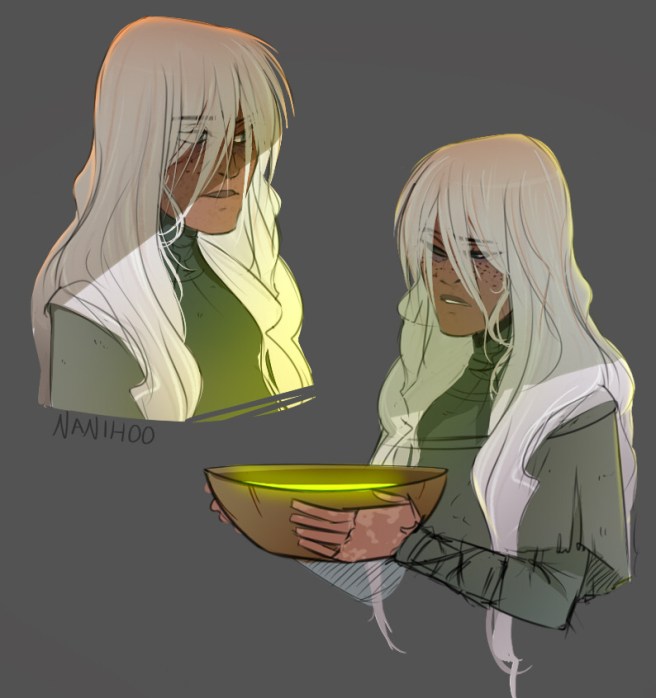













 Holding the Bowl