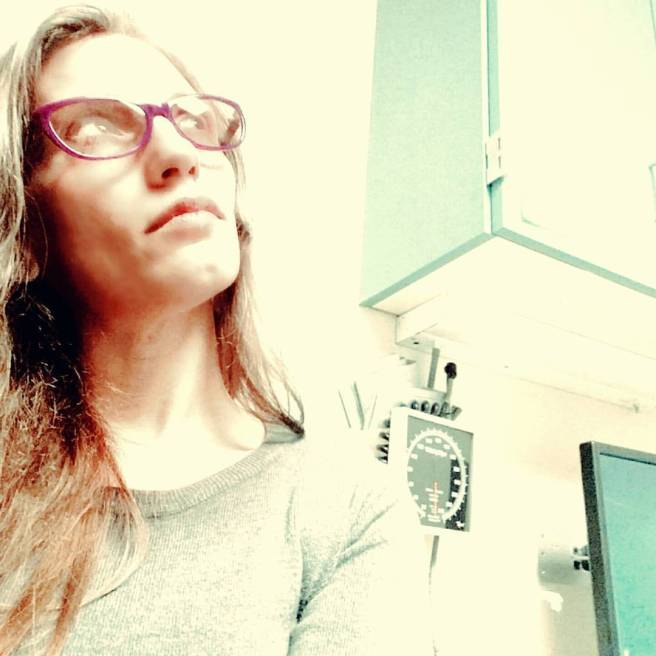
Hot shot of yours truly sporting my new #AxonOptics Migraine Glasses. #prettyinpink These are the Dalliance style with indoor lenses and pink frames. I am super-duper pumped for the opportunity to demo these glasses free for honest review through my membership with @chronicblogs
Be looking for my full review up on OnlyinthisHead.com in the next couple months!
In the last year, I’ve sat in roughly 30 different doctor’s offices and every last one used fluorescent lighting sources. As if these appointments weren’t painful enough!
Fluorescent lighting is a big trigger for not only my migraines but also my sensory issues.
The flickering and artifical brightness makes for misery business when trying to clearly communicate my needs. Something about those tubular beams of unnatural lighting activates my my brain fog something fierce! Since getting the chance to review these glasses, fluorescent lighting is a barrier I now succeed!
These glasses are the real deal!
Not only do they look super-duper cute but they also help me get through appointments without triggering my migraines, protecting my sensitive eyes from the assault of fluorescent lighting. At the same time, the lenses are not so dark people can’t see my eyes nor is it difficult to see while wearing them in lower lighting.
Just taking care of this small factor in my chronic illness life with ehlers-danlos makes a big difference overall in this journey!
I cannot recommend Axon Optic’s line of migraine relief glasses to others with lighting sensitives enough!
[Image Description: selfie shot of Dawn in the doctor’s office. She has long, medium brown hair with a large grey streak in the front, parted to the side with the bulk of her hair laying along one shoulder. She is wearing a grey sweater and pink framed glasses with tinted lenses. She is looking up defiantly and the reflection of fluorescent lights are in the lenses. In the background is a blood pressure cuff attached to a cabinet with a computer underneath.]
#chronicillnesslifestyleblogger #Migraine #photosensitive #Ehlers-DanlosSyndrome #migrainerelief #freeforreview #ilovemyaxonoptics #flourescentlights #theseaintcheapsunglasses
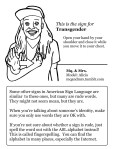
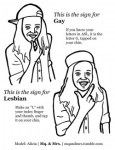
hey i made gifs of these so that ppl can see what they look like !! since sometimes just seeing pictures doesn’t always get the sign across
queer:
bi:
transgender:
gay/lesbian:
Awesome
For all my deaf / mute LGBTQ followers or anyone trying to learn
This is such a great post! Deaf and hard of hearing people are members of our community, so let’s show them some love. You can learn ASL online using the resources in this post: http://mashable.com/2014/04/21/how-to-sign/#SdHJ06gZ1Zqy
I will never not reblog this. It’s so hard to come across this post and this ain’t something ASL class will teach you. Sign language is spectrum of widely used languages (they differ country to country) and you never know when you’re going to need it.
Girls who use mobility aids deserve support and kindness! No one is too young to use a cane, wheelchair, crutches, or any other sort of aid that helps with day to day living. Assuming someone is too young or “just trying to get attention” is completely ignorant and actively harms disabled people. Disabled girls are allowed to like, enjoy, and find their mobility aids cute without others shaming them or passing judgments. Being disabled isn’t a bad thing and isn’t something only the elderly experience.
NEW YORK — Justin Bainbridge is 27 and works two jobs, but he wasn’t
allowed to start saving money for his future until a few months ago.
Bainbridge
has Down syndrome, and like other people with disabilities who receive
government benefits, he can’t have more than $2,000 in savings. If he
does, he would start to lose those much-needed benefits. But a new type
of savings vehicle is giving Bainbridge, and others, a chance to save
more cash.
Known as ABLE accounts, they let people with
disabilities and their families save up to $14,000 a year without losing
benefits. The accounts, which were made possible by a law signed two
years ago, are operated by individual states and are similar to 529
college savings plans. So far, 16 states offer the plans and about 10
more are expected to do so this year. Most of the states let
non-residents sign up. Each state has different rules or maintenance
fees, with some charging as much as $15 every three months.
Disability
advocates say the accounts are badly needed, since people with
disabilities were forced to spend extra money to avoid losing benefits.
With ABLE accounts, money saved can be used to buy anything that helps
the life of the person with a disability, such as rent payments, school
tuition or groceries.
“I’m saving for a new couch,” says Bainbridge, who shares a two-bedroom apartment in Omaha, Nebraska, with a friend.
Since
June, he has put away more than $1,800 in an Enable account, the ABLE
program run by Nebraska. He makes about $5,200 a year from his part-time
jobs, one folding towels at a gym and another collecting movie tickets
at a theater. But he still needs his monthly Supplemental Security
Income cash benefit to help pay his rent and live independently, says
his mother, Kim Bainbridge, who also stashes away money for him in the
ABLE account.
For
years, disability advocates have tried unsuccessfully to increase the
$2,000 savings limit, which hasn’t been changed in nearly three decades.
“It
kind of shackles you to a life of poverty,” says Christopher Rodriguez,
a senior public policy adviser at the National Disability Institute in
Washington.
The idea for ABLE accounts came about a decade ago
from parents of kids with disabilities who were frustrated that they
could not easily save money for their children. One of those parents,
Stephen Beck Jr., spent years advocating and lobbying for a law. Beck
unexpectedly passed away in 2014, just a few weeks before President
Barack Obama signed it into law. To honor Beck, the law was named The
Stephen Beck Jr. Achieving a Better Life Experience Act.
His
widow, Catherine Beck, is using an ABLE account to put away money for
their 17-year-old daughter Natalie, who has Down syndrome and wants to
go to cosmetology school to work at a nail salon. The Becks were able to
easily save money for their eldest daughter, who does not have a
disability. But for Natalie, they had to create a special-needs trust
that required hiring a pricey lawyer to set up.
“Her savings has not grown like her sister’s has,” says Catherine Beck, who lives in Burke, Virginia.
To
qualify for an ABLE account, the account owner must have had a
disability before their 26th birthday. Anyone can put money in it, such
as family or friends. If the account goes above $100,000, the person
with the disability will lose monthly government cash benefits until it
drops below that level again. Medicaid health benefits are never
affected, no matter how much money is saved. Money can be invested in
index funds and earnings are not taxed.
“For the first time a lot
of individuals will be able to work, save money and get some growth out
of it,” says Adam Beck, director of MassMutual Center For Special Needs
at The American College in Bryn Mawr, Pa.
When
the person with a disability dies, Medicaid can claim any leftover
money as payback for health care paid after the ABLE account was opened.
Since each state has different rules and fees, the ABLE National
Resource website has a tool that compares the programs.
Matthew
Shapiro, who lives in Richmond, Va., and works to promote the state’s
ABLE program called ABLEnow, says finally being able to have some
savings helped reduce his money worries. The 26-year-old, who has
cerebral palsy, uses a power wheelchair to get around and unexpected
repairs can be costly. He travels sometimes for his business, 6 Wheels
Consulting, which helps educate companies and organizations on
disability issues.
“Being a person with a disability is expensive,” says Shapiro. “These accounts are so much needed.”
Fact: Autistic, developmentally disabled and intellectually disabled adults can be childLIKE, but they are not children. They can have childlike qualities and like things usually associated with children, but they are still ADULTS.







 Holding the Bowl