How does one describe a sunset?” she asked. “It is impossible. It is both grand and beautiful and with it brings the dark night. That was my Loki. He was the brilliance that brought the darkness.
My husband gave me an idea ages ago, and I wanted to actually put it into motion. So today, I give you the ‘Being Visible’ line of shirts.
The goal of Being Visible is to allow people with mental illness, or other invisible illnesses, to help make people aware of their coping abilities on any given day by using the simple image of a battery at various charging levels:
Low charge – low ability to function ‘normally’ or perform daily tasks. May need assistance or frequent breaks Medium charge – diminished, but capable of performing routine or simple tasks during the day. Some assistance may be needed. Full charge – able to perform daily tasks with little to no assistance or reduction in speed, effort, etc. Little to no assistance needed.
These images will be placed front and centre of various T-shirt/tank top designs, to enable wearers to non-verbally alert people around them of their limitations, if they so choose. Of course, as ability levels change, so too can the shirts. On the back of the shirt is the simple text line ‘Being Visible’ above the rod of Asclepius, the common symbol for medicine.
75% of the proceeds will go to the American Foundation for Suicide Prevention. The remaining 25% will go towards my ability to purchase several units of each shirt for my own use.
You can find the shirts at the links listed below. The target goal is 75 units each.
All slides have a light blue background, and the text is written in blue rectangles with rounded corners.
Slide 1: The title is in white text inside a dark blue circle that is centred in the slide.
Sensory Overload And how to cope
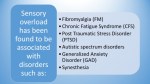
Slide 2: The header is in a dark blue rectangle and white text, and the body is in a pale blue rectangle and black text.
Sensory overload has been found to be associated with disorders such as:
Fibromyalgia (FM)
Chronic Fatigue Syndrome (CFS)
Post Traumatic Stress Disorder (PTSD)
Autistic spectrum disorders
Generalized Anxiety Disorder (GAD)
Synesthesia
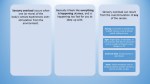
Slide 3: The text is in three pale blue rectangles that
go horizontally across the slide. All use black text. The last
rectangle has four smaller dark blue rectangles with white text inside
it for the four points. The text is centred in all of the rectangles.
Sensory overload occurs when one (or more) of the body’s senses experiences over-stimulation from the environment.
Basically it feels like everything is happening at once, and is happening too fast for you to keep up with.
Sensory overload can result from the overstimulation of any of the senses.
Hearing: Loud noise or sound from multiple sources, such as several people talking at once.
Sight: Bright lights, strobe lights, or environments with lots of movement such as crowds or frequent scene changes on TV.
Smell and Taste: Strong aromas or spicy foods.
Touch: Tactile sensations such as being touched by another person or the feel of cloth on skin.
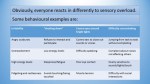
Slide 4: A heading in two light blue rectangles with black
text, followed by a table with a dark blue first row that has white
text, and then alternating pale blue and white rows with black text.
(The table is not really a table, it is just a four-column list.)
Obviously, everyone reacts in differently to sensory overload.
Some behavioural examples are:
Irritability — “Shutting down” — Covers eyes around bright lights — Difficulty concentrating Angry
outbursts — Refuses to interact and participate — Covers ears to close
out sounds or voices — Jumping from task to task without completing Overexcitement — Low energy levels — Difficulty speaking — Compains about noises not effecting others High energy levels — Sleepiness/fatigue — poor eye contact — Overly sensitive to sounds/lights/touch Fidgeting and restlessness — Avoids touching/being touched — Muscle tension — Difficulty with social interactions
Slide 5: The header is in a dark blue box with pointy
corners and white text. The body is in a pale blue box with pointy
corners and black text.
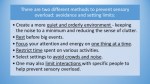
There are two different methods to prevent sensory overload: avoidance and setting limits:
Create a more quiet and orderly environment – keeping the noise to a minimum and reducing the sense of clutter.
Rest before big events.
Focus your attention and energy on one thing at a time.
Restrict time spent on various activities.
Select settings to avoid crowds and noise.
One may also limit interactions with specific people to help prevent sensory overload.
Slide 6: This looks the same as the last slide except the text in the header is black.
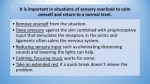
It is important in situations of sensory overload to calm oneself and return to a normal level.
Remove yourself from the situation.
Deep pressure against the skin combined with proprioceptive input
that stimulates the receptors in the joints and ligaments often calms
the nervous system.
Reducing sensory input such as eliminating distressing sounds and lowering the lights can help.
Calming, focusing music works for some.
Take an extended rest if a quick break doesn’t relieve the problem.
Slide 7: Four light blue rectangles with rounded corners, stacked one above the other, with black text.
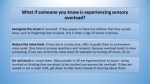
What if someone you know is experiencing sensory overload?
Recognize the onset of overload. If they appear to
have lost abilities that they usually have, such as forgetting how to
speak, this is often a sign of severe overload.
Reduce the noise level. If they are in a noisy area,
offer to guide them somewhere more quiet. Give time to process
questions and respond, because overload tends to slow processing. If you
can control the noise level, for example by turning off music, do so.
Do not touch or crowd them. Many people in SO are
hypersensitive to touch – being touched or thinking they are about to be
touched can worsen the overload. If they are seated or are a small
child, get down to their level instead of looming above them.
Slide 8: Similar to previous slide, only with three rectangles instead of four.
Don’t talk more than necessary. Ask if you need to
in order to help, but don’t try to say something reassuring or get them
talking about something else. Speech is sensory input, and can worsen
overload.
If they have a jacket, they may want to put it on and put the hood up. This
helps to reduce stimulation, and many people find the weight of a
jacket comforting. If their jacket is not within reach, ask them if they
want you to bring it. A heavy blanket can also help in a similar way.
Don’t react to aggression. Don’t take it personally.
It is rare for someone who is overloaded to cause serious harm, because
they don’t want to hurt you, just get out of the situation. Aggression
often occurs because you tried to touched/restrained/blocked their
escape.
Slide 9: Similar to previous slide, only with two rectangles instead of three.
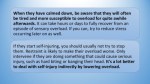
When they have calmed down, be aware that they will often be tired and more susceptible to overload for quite awhile afterwards. It
can take hours or days to fully recover from an episode of sensory
overload. If you can, try to reduce stress occurring later on as well.
If they start self-injuring, you should usually not try to stop them.
Restraint is likely to make their overload worse. Only intervene if
they are doing something that could cause serious injury, such as hard
biting or banging their head. It’s a lot better to deal with self-injury indirectly by lowering overload.
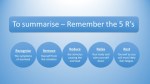
Slide 10: The header is in a dark blue rectangle with white
text, and the other text is in a row of five dark blue circles with
white text. The text is centred in all shapes.
To summarise – Remember the 5 R’s
Recognise The symptoms of overload
Remove Yourself from the situation
Reduce the stimulus causing the overload
Relax Your body and calm yourself down
Rest Yourself as you will most likely feel fatigue.]
I know a lot of us encourage self-care strategies to deal with the many diverse things we face. I thought this was a good article on the difference between kind self-care and reflective self-care, and while many of us have learned or are learning about the former, many of us are still missing out when it comes to the latter.
Tumblr is my fun place, so I don’t usually get into this here, but… reasons.
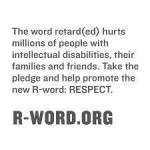
Lovely people here sometimes use the word ‘Retard’ or ‘Retarded’ or some variation (ie ’________-tard’) and those lovely people do NOT mean anything at all against people with cognitive or physical disabilities.
I understand. I get it. Seriously! I’m not being sarcastic at all. This is on my mind in the friendliest of ways. I don’t mean to embarrass or offend. I just hope to help you understand.
My younger son was born with Down syndrome. He’s doing well (learning, growing, healthy) and I adore him. I’m proud of him. But, for me, slurs against people with disabilities strike a painful nerve. It’s personal. It brings up every fear I’ve ever had about my son being bullied or abused. It hurts.
I can’t step off this soapbox. Life put me on it for keeps.
So, please, consider yourlanguage. 😉 Help End the ‘R’ Word.
Happy international women’s day to autistic women, transgender women, lesbian women, asexual women, bisexual women, pansexual women, women with mental illness, disabled women, and just all women!! You are all gorgeous 💚💚
There have been articles making the rounds again that psychologists are suggesting a certain someone has a severe mental illness.
Again. This is happening again. This spread of information and headlines, and clickbait, and general tomfoolery surrounding mental illness is once again making my disappointment in humanity rise.
First, it was the armchair doctors on social media saying ‘He’s crazy, he’s clearly got issues, he must have [insert dx here]’ Then, it was the preliminary rounds of ‘Psychologists are suggesting that he has a mental illness.’ Now, it’s ‘Psychologists are suggesting that he has a severe mental illness.’
How about….and I know this is super unheard of….
WE CUT THAT SHIT OUT?
I don’t care whether or not he has a mental illness. I do care if he gets help, sure. But this….this whole idea that we can explain away the horrible things he’s done or said or blundered up with ‘mental illness’ is absurd. Or, if you’re not using it to explain his horrible behaviour, you’re using it to exemplify his lack of fitness to do his job.
BOTH OF THESE LINES OF THINKING CAUSE HORRIBLE PROBLEMS.
So, let’s start from the beginning. Psychologists, as medical professionals, should really fucking know better than to throw out even the suggestion of a diagnosis to the press, knowing full well the horrible stigma that still surrounds mental illness to this day. On top of that, as medical professionals, it’s kinda rude to be talking about someone, regardless of how high-profile they are, in a medical context outside of the context of their care. You don’t see oncologists blasting that so-and-so probably has cancer all over the press, so why are you broadcasting very real illnesses like they’re some kind of joke?!
Furthermore, mental illness is not an indication of someone’s ability to say or do horrible things. I’ve been in a fight like this before, and it’s really not fun. Not only does using mental illness as a catch-all for horrible behaviour endanger the victims of said person’s horrible behaviour (or at least fail to vindicate and acknowledge the harm said person is doing with the aforementioned behaviour,) it also removes accountability from the person in question, especially one with blame-shifting tendencies. ‘Oh, he doesn’t know what he’s doing, he’s mentally ill.’ This line of reasoning suggests that mentally ill people are unpredictable, volatile, and a danger to others. This is not always the case, and it’s a dangerous precedent to set, much like the HIV/AIDS crisis in the 80s [people being avoided for fear of contagion/people avoiding mentally ill people for fear of harm, people generating horrible stereotypes because of an illness that’s still misunderstood…]
On to the next point. Mental illness does not mean an inability to do one’s job. Ever. Full stop. Next question, please. High profile duties sure do require a lot of stamina, both physically and mentally. But DO NOT TELL ME that mental illness precludes someone from being a capable, functional member of society. I will shred you with my WORDS. Mental illness, much like any other illness, will set limits for each individual with a diagnosis. Some people have lower limits than others, and THAT IS OKAY. But to suggest that the reason someone is unfit because of a hypothetical diagnosis just fuels the hate fire that is mental health stigma, and I will fight to the death to make sure that that slows down or ends.
I’ve experienced workplace discrimination because of my limits that are caused by mental illness and self-care. Do you have any idea how demoralising that is? It makes it WORSE. I was passed up for promotions, told it’s useless to try, and not taken seriously when I had legitimate concerns about how things were being done. Eventually, the amount of nonsense I was dealing with came to a head, and I was forced to resign or risk my health.
People are already not listening when we try and make mental health a serious and valid issue, and this is NOT helping. It’s an insult to the movement that vies and pushes for mental illness to be treated the way it deserves to be treated in society; as a medical condition, a quirk/downfall/dysfunction/pick-a-word of one of the most important organs in the human body. Articles floating around in the news about how readily someone can be slapped with the label of mentally ill sends more people away from help and care, because they are afraid of what will happen if people find out.
Cut.that.shit.out.
Treat mentally ill people as people, ask them what their needs are, remember that they are more than medication and therapy and the doctors on their prescription labels. They are people, who deserve respect from a society that’s lambasting them without even acknowledging the harm.










 Holding the Bowl