


Fuzzy #zebraprint #kneelengthsocks with #pink trim ❤ ❤ ❤
The Ehlers-Danlos Syndromes is often symbolized by zebra stripes. In the early days of modern medical training, the school of thought was if you hear hoof beats, expect horses…not Zebras. Since then, this archaic philosophy harmed many of us living with EDS.
We persevere against great adversity to find a diagnosis holding the answers for lifetimes of pain and dysfunction. Still, we face countless dismissals from less educated practitioners. The Ehlers-Danlos Syndromes, particularly Hypermobility EDS, is intensely more common than once thought. Turns out, the Zebra analogy of the early days of formalized medicine is obsolete!
Even so, my Zebra peeps stake no less in our beloved mascot. The analogy shifts towards the unique characteristics to each, individual Zebra’s stripes. No two Zebra share the same stripe pattern and the same applies to those with any of the Ehlers-Danlos Syndromes. Each of us presents differently, making care management challenging to even the most seasoned practitioner.
Some of us walk, run and work…
Some of us used to…
Some of us will again…
And still, some of us never experience independent functions…There are too many factors in calculating how different people respond to life with a chronic, progressively disabling conditions but the constant remains: Awareness improves outcomes!
Ten years ago, even with multiple pains, life threatening lab values, and distressing symptoms my doctors could never say what was causing my multisystemic dysfunction. Now, I finally know why but meet with disability because the damage can’t be undone.
This is why I can’t stop talking about EDS! I want others like my former self to know there are answers and hope for better quality of life with diagnosis. It shouldn’t be so hard but the #EDSSociety is taking great strides to ensure the awareness documentation is readily accessible for doctors who want to learn and doctors ignorant to the reality of this complex process. Finally, it’s a start & #ItsOurTime ❤
#EDSawareness #ZebraStrong #vascularehlersdanlossyndrome #pots #chronicillness #wheelchairuser #filas #knobbyknees
PSA to our followers this Autism Acceptance Month:
- Use Autism **Acceptance** Month (as opposed to Autism Awareness Month).
- NO “light it up blue” or puzzle pieces. Google “Autism Speaks hate group” to learn more.
- Use red or gold instead, which are colors supported by the autistic community.
- Use identity-first language (most autistic people prefer “autistic” instead of “person with autism”), but don’t police the language of someone who prefers to be called a person with autism.
- NO scare terms like “suffering with autism” or “afflicted with autism.”
- Avoid functioning labels like “high functioning” or “low functioning.”
- If autistic voices are not at the center of your efforts, you’re doing it wrong.
- When in doubt, ASK AN AUTISTIC PERSON.
- To learn more about autism, visit autistic-run organizations like the Autistic Self Advocacy Network (ASAN) and Autism Women’s Network (AWN).

The beginnings of an altar to Sigyn and other members of the Æsir, in particular Loki and Odin.
About Executive Dysfunction; for neurotypical people
Friends, family members and loved ones of learning disabled and mentally ill people need to have a working knowledge of what Executive Dysfunction is, and respect the fact that it is a prominent feature of that person’s psychology and life.
Executive Dysfunction is best known as a symptom of autism and ADHD, but it also features in depression, anxiety disorders schizophrenia, OCD (which by the way is also an anxiety disorder), personality disorders; etc, a whole myriad of mental illnesses and disabilities can result in executive dysfunction.
Years ago when I was like 14 and had recently learned of my autism diagnosis, I watched a youtube interview between autistic people, and an autistic woman said something along these lines:
- “Sometimes, a lightbulb will burn out, but I cannot change it. I have the physical capability to change the lightbulb, and I want to change the lightbulb, and I know I need to do it, but because of my autism I just don’t do it. So the lightbulb remains unchanged for weeks. Sometimes people have to change the lightbulb for me.”
When she said that I related so much, because constantly throughout my whole life I have wanted and needed to do things with my wanting and needing being akin to my spurring an extremely stubborn horse who refuses to move. For the first time I learned that I wasn’t just “lazy”, I had a condition that prevented me from doing things as easily as other people can, but unfortunately it took me years since then to understand that.
Imagine that you are a horserider, but your horse is entirely unwilling to move even if you want to move. You dig in your heels, you raise the reins, but the horse refuses to respond. Your wants and needs are the rider, and your executive functions (the parts of your mind responsible for getting things done) are the horse.
I think it’s incredibly dangerous for neurotypical loved ones to not understand, or be aware of, or respect executive dysfunction. Neurotypical can assume that we are just being lazy, careless, selfish or difficult, when in reality we want to do the thing but our brains prevent us from consistently and reliably doing the thing.
That misinterpretation can lead to toxic behavior and resentment on the part of the loved one, which will harm us emotionally and do us a lot of damage gradually over time.
That damage can take the form of internal self-criticism, complicating executive dysfunction even further and making it worse.
edited for easier reading!
I think about this a lot, because I have to. In my own life, as a parent who struggles with executive dysfunction and yet has to teach a child basic life skills, it’s important to know my blind spots and learn to function around them. He’s watching me and learning from my example, so I have to do my best to explain what I can’t always do, and try to do it anyway.
Executive function is such a fundamental and yet hidden trait. It is in charge of reasoning, flexibility, problem solving, planning, and execution/prioritization of necessary steps in any action.
Each task is never one task. Take changing the lightbulb – from beginning to end, it’s a series of steps that must be put in proper order:
- Notice light bulb is burnt out.
- Recognize that it can be fixed by putting in a new light bulb
- Remember where new light bulbs are stored
- Go to light bulb storage area
- Select new one
- Find stool or chair to stand on
- Take out old bulb, put in new one
- Screw in bulb
- Replace chair or stool to previous spot
- Throw away old bulb
That’s not even all of them, but it’s a good enough summary for now. There are hidden stumbling blocks in every single step.
- A burnt out bulb may go unrecognized as a problem – there’s two other bulbs in the room, it’s a little dimmer, so what? It might take all three burning out before you see it as a problem.
- Maybe you forgot where the bulbs are, because it’s been a while. Searching the house is a task you put off, because it’s messy/disorganized/big/you have other more pressing matters. The bulb can wait.
- You find the bulb storage, but you’re out of new ones. You have to shop. You’re busy, you put it off until the next time you shop, by which time you’ve forgotten you need a light bulb. Repeat cycle.
- You’ve been depressed for a while, or maybe you’re just a messy person. A stack of important documents is on the chair you’d use to stand on to get to the bulb. You know if you move those documents you’ll forget where they are, and it’s tax stuff/homework/your mom’s birthday card, and you can’t forget that. The bulb gets put aside until you deal with those things. But you don’t want to deal with them now, so the bulb waits.
- Throwing out the bulb requires safe disposal so that you don’t break it and accidentally cut yourself, or someone else in your home. You have no idea how to safely dispose of it. You put off changing the bulb until you figure out what to do with the old one.
On and on and on. Each step requires problem solving, prioritization, and reasoning. These are the hidden processes that go on in our minds every single moment of every day. Difficult tasks build up, compounding the problem of completing others, until each action requires ten more before you can solve the minor problem you started with. Changing a light bulb ends in a night of doing your taxes. Doing the dishes ends in standing in the dish soap aisle at the grocery story for a half hour trying to figure out which soap to buy for the dishwasher.
When a simple action requires the same effort from you as the most complex, abstract problem-solving…. to put it mildly, you’re fucked. Every day tasks require exhausting mental gymnastics.
So, be kind to the person who can’t seem to change a light bulb. There’s a lot that can stand in the way.
this is such a good addition to my post
Important info!
“Difficult tasks build up, compounding the problem of completing others, until each action requires ten more before you can solve the minor problem you started with. Changing a light bulb ends in a night of doing your taxes. Doing the dishes ends in standing in the dish soap aisle at the grocery story for a half hour trying to figure out which soap to buy for the dishwasher.”
I relate to this so hard.
PSA
What helps your medical condition might not help other people
What you are comfortable doing to help heal yourself might not be in other people’s comfort zones
The choices you make medically may not be the same choices other chronically ill/disabled/nuerodivergent people make
Respect each other’s medical choices and don’t press them to try something just because it helped you; they might not be comfortable with it and it may not even benefit them.
We have enough adversity from the able-bodied community assuming we all need yoga and vegan diets, please try not to add to that when speaking to your fellow disabled friends.









✨ happy autism acceptance month! ✨
here are my favorite autistic characters, both canon and headcanon! allistics are welcome to reblog + link to list of characters used here + link to roseytones’s post + link to some further reading
2017 Camp Registration: Return of the Lottery


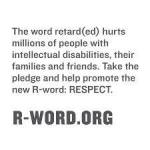

Please do not use The ‘R’ Word
Tumblr is my fun place, so I don’t usually get into this here, but… reasons.
Lovely people here sometimes use the word ‘Retard’ or ‘Retarded’ or some variation (ie ’________-tard’) and those lovely people do NOT mean anything at all against people with cognitive or physical disabilities.
I understand. I get it. Seriously! I’m not being sarcastic at all. This is on my mind in the friendliest of ways. I don’t mean to embarrass or offend. I just hope to help you understand.
My younger son was born with Down syndrome. He’s doing well (learning, growing, healthy) and I adore him. I’m proud of him. But, for me, slurs against people with disabilities strike a painful nerve. It’s personal. It brings up every fear I’ve ever had about my son being bullied or abused. It hurts.
I can’t step off this soapbox. Life put me on it for keeps.
So, please, consider your language. 😉 Help End the ‘R’ Word.
Thank you.
Bringing this back because
today is World Down syndrome Day
(3/21 for the three copies of the 21st chromosome that define Ds).
I’m glad this post has gotten some reblogs. Our world needs more kindness, compassion, and consideration. Please do not use the ‘R’ word.
 Holding the Bowl