spacemomnephmoreau:

kosmonauttihai:

rollerskatinglizard:

ceekari:

stayhungry-stayfree:

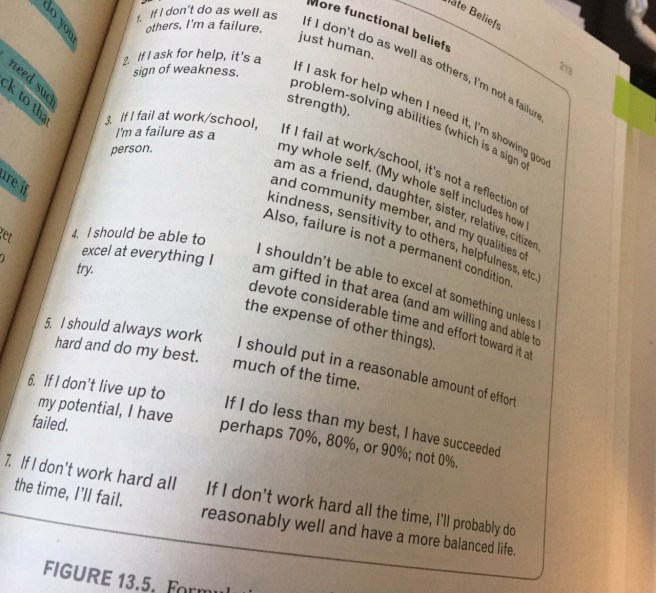
This is a really helpful page in my CBT textbook for tackling some of the maladaptive beliefs we often hold. The first column lists the rules and assumptions we often may tell ourselves, while the second column is a more functional belief. Just thought I would pass this along. Be kind to yourselves, friends❤

Oh my god, number 5. And 6, and 7.

I frigging needed that.

Failure is not a permanent condition.

The text on the image:

  1. Maladaptive belief: 

    If I don’t do as well as others, I’m a failure.
    More functional belief:

    If I don’t do as well as others, I’m not a failure, just human.

  2. Maladaptive belief:  If I ask for help, it’s a sign of weakness.
    More functional belief: If I ask for help when I need it, I’m showing good problem-solving abilities (which is a sign of strength).
  3. Maladaptive belief:  If I fail at work/school, I’m a failure as a person.
    More functional belief:

    If I fail at work/school, it’s not a reflection of my whole self. (My whole self includes how I am as a friend, daughter, sister, relative, citizen, and community member, and my qualities of kindness, sensitivity to others, helpfulness, etc.) Also, failure is not a permanent condition.

  4. Maladaptive belief:  I should be able to excel at everything I try.
    More functional belief: I shouldn’t be able to excel at something unless I am gifted in that area (and am willing and able to devote considerable time and effort toward it at the expense of other things.
  5. Maladaptive belief:  I should always work hard and do my best.
    More functional belief: I should put in a reasonable amount of effort much of the time.
  6. Maladaptive belief:  If I don’t live up to my potential, I have failed.
    More functional belief: If I do less than my best, I have succeeded perhaps 70%, 80%, or 90%; not 0%.
  7. Maladaptive belief:  If I don’t work hard all the time, I’ll fail.
    More functional belief:

    If I don’t work hard all the time, I’ll probably do reasonably well and have a more balanced life.

Many of my girls need to accept this.
lokisarmee4ever:

It´s a little bit sad that there is just so few sources about Sigyn, as I really like her. Sigyn is the godess of fedility and loyality and – for a long time now – my life has been controlled by those things. Way before I knew more about Sigyn. I am known to be very loyal to my friends and loved ones and as a lokean by heart I am so god damn unbelievable loyal to Loki. And, in those moments I feel loyal for someone, that´s Sigyn. The person that trusted and loved and encouraged her husband even after she saw her own son taken appart. 

I am currently writing a dedication book about Loki and his fam and it´s just so sad that there isn´t much about Sigyn known. I´m thinking of pressing some flowers (that may represent loyality) and glueing it in too. And some prayers and thoughts on Sigyn. But besides that? I don´t know how I could honor her even though I want to more and more. 

Maybe some of you guys have an idea? 🙂 

hoosierbitch:

da-at-ass:

If you’ve got persistent/chronic illnesses and/or fatigue, you have permission to be tired. You have permission to not get all the things done right now. You have your own time you do things within, and it is perfectly okay to take that time and move at your pace and rest when needed.

Even when things are going well and exciting stuff is happening! Even when you feel that now that things are taking a turn for the better, your energy and spoons should be going up too! You don’t have to recover and be full of energy automatically, you’re not lazy if you have to rest. If your bones and muscles say “nope” then it is okay for you to decide that it’s time to stop, regardless of how nice a day it is, regardless if it seems like the perfect time to do a given chore. Don’t feel obligated to spend your time on work just because you feel like you should be busy.

I am typing this to myself to make it click.

reminder to self.

lysikan:

geekdawson:

one of the more valuable things I’ve learned in life as a survivor of a mentally unstable parent is that it is likely that no one has thought through it as much as you have. 

no, your friend probably has not noticed they cut you off four times in this conversation. 

no, your brother didn’t realize his music was that loud while you were studying. 

no, your bff or S.O. doesn’t remember that you’re on a tight deadline right now.

no, no one else is paying attention to the four power dynamics at play in your friend group right now.  

a habit of abused kids, especially kids with unstable parents, is the tendency to notice every little detail. We magnify small nuances into major things, largely because small nuances quickly became breaking points for parents. Managing moods, reading the room, perceiving danger in the order of words, the shift of body weight….it’s all a natural outgrowth of trying to manage unstable parents from a young age. 

Here’s the thing: most people don’t do that. I’m not saying everyone else is oblivious, I’m saying the over analysis of minor nuances is a habit of abuse. 

I have a rule: I do not respond to subtext. This includes guilt tripping, silent treatments, passive aggressive behavior, etc. I see it. I notice it. I even sometimes have to analyze it and take a deep breath and CHOOSE not to respond. Because whether it’s really there or just me over-reading things that actually don’t mean anything, the habit of lending credence to the part of me that sees danger in the wrong shift of body weight…that’s toxic for me. And dangerous to my relationships. 

The best thing I ever did for myself and my relationships was insist upon frank communication and a categorical denial of subtext. For some people this is a moral stance. For survivors of mentally unstable parents this is a requirement of recovery. 

If it wasn’t stated outright – it wasn’t said.

Can Alexa’s new telephone calling system replace traditional emergency pendant alarms?

livingwithdisability:

The telecare industry provides peace of mind for people at home who may need help in an emergency and their families, traditionally using push button pendants worn on the body or pullcords installed in the house. The Alexa Echo system means you won’t even need to access those devices to make a call straight to your nearest and dearest, so could provide competition.On the plus side, there are no buttons to be pushed or cords to be pulled. Only your voice is needed to activate Alexa and get your call made or message sent to your friends or relatives. All they need to do is download the free app onto their phones, and they can be reached instantly whenever you want. It does mean they will need their phones on and charged at all times. It also means that you need to be in voice range of an alexa device and able to call out. You could buy the smaller

echo dot (at £50) and put them in each room. There is a voice operated controller

that could also be carried.And it’s not just in an emergency that you can make a call. Alexa will let you stay in touch all the time, with a hands-free calling and messaging system. this could be very useful for people who struggle with the buttons on phones or understanding how to use smart phones. Alexa will let also let you know when someone is calling you and the light ring will pulse green on newer Echo devices. You ask Alexa to answer or ignore the call.“Drop in” : remote listening by others to your room!

There is also a feature called Drop In that allows selected family and friends to automatically call in to your device and listen to anything happening in range. This has privacy issues but could also be very reassuring to family and can be completely controlled by the owner of the device.

Some people may be reluctant to have telecare installed because of the stigma issues of pendants and monitoring. ‘Alexa telecare’ may be much more appealing to younger people or as a stepping stone to more traditional telecare if it becomes needed or as a supplement to offer more options and a ‘less formal’ call for help.

Read more at –http://livingwithdisability.info/alexa-telecare/

Read more at –

http://livingwithdisability.info/alexa-telecare/

US-based links to the Amazon Dot and Controller, as well as the US-based Amazon Help article on the Drop In feature. (for those interested)

firefoxalchemy:

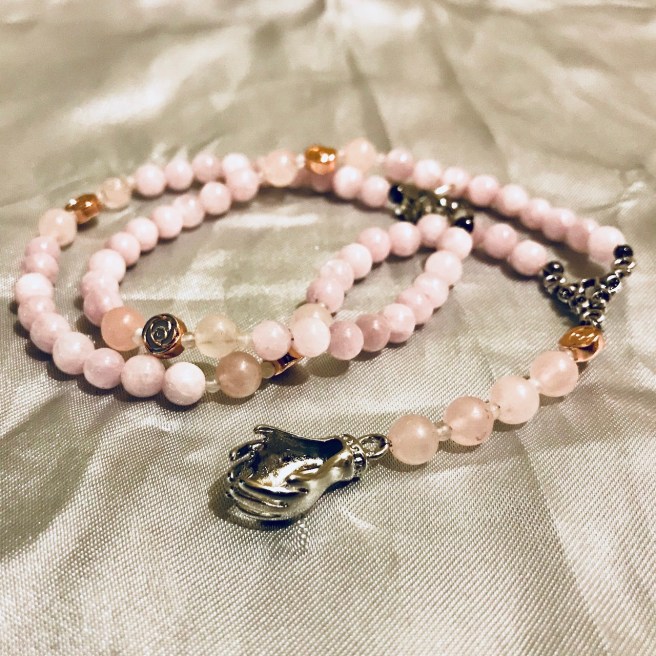
With Arms Wide Open: Prayer Beads for Sigyn.

Sigyn is the Norse Goddess of Fidelity.

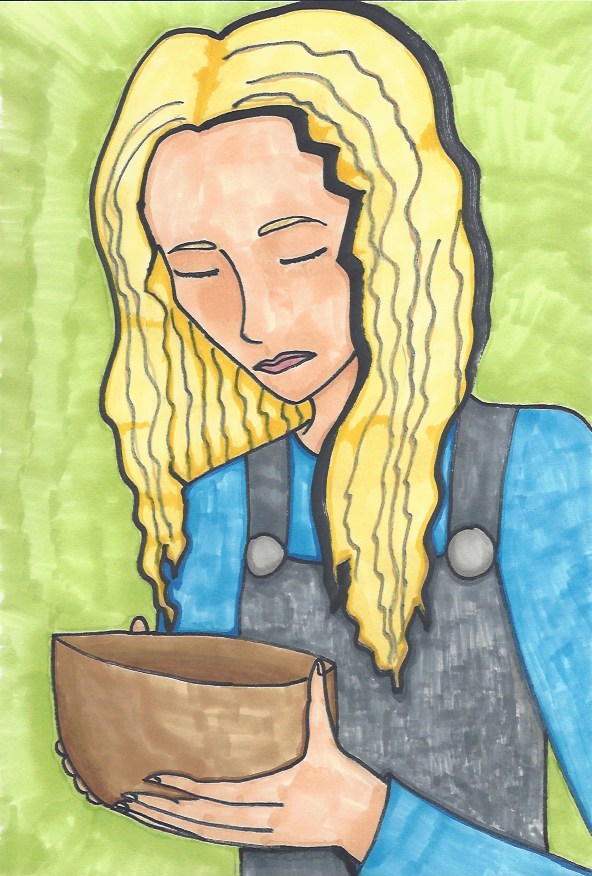
Sigyn is Wife to Loki, The Trickster God. Not much is mentioned of Her in the Eddas. The most famous mention of Her is during Loki’s punishment. He is bound and chained deep in a cave and a snake has been fashioned over His head to drip venom on his face. To ease Her husbands suffering, Sigyn holds a bowl over Loki’s head to catch the venom. Every so often, She has to leave to empty the bowl. When She does, the venom that hits Loki’s face causes Him great agony. She continues holding the bowl over His head until He eventually breaks from His bounds at Ragnarok.

Sigyn is know as a devoted Wife and Mother. This set is crafted with that in mind. Made with soft pink Kunzite and Rose Quartz, as well as Rose Gold Hematite. Two silver cupped hands represent Her holding the bowl that shields Her husbands head.

Will come beautifully packaged in a black jewelry box with wax seal.

https://www.etsy.com/listing/566026175/with-arms-wide-open-prayer-beads-for?ref=shop_home_active_1

nathanialroyale:

papi-chulo-bucky:

thatawkwardtinyperson:

pitbullmabari:

catwinchester:

catwinchester:

iamhisgloriouspurpose:

writernotwaiting:

anastasiaoftheironwood:

writernotwaiting:

sweetheart-sona:

invaderxan:

bigbardafree:

not-safe-for-earth:

lavandulum:

i’ve stopped trash talking comic sans after learning the font is actually one of the only dyslexia-friendly fonts that come standard with most computers and i advocate for others doing the same

In the event that you would like to continue hating Comic Sans, other dyslexia-friendly alternatives include Arial, Verdana, Tahoma, Century Gothic and Trebuchet.

thank

Random fact: Verdana is one of the few fonts which was specifically designed to be as easy to read as possible, even at smaller type sizes. It was designed this way for use on screen, but the same principles apply in print too. This is part of why some Universities use Verdana as their default font for documents.

“In the event that you would like to continue hating Comic Sans” is one of the best things I’ve ever read on this website

@pedeka @lunariagold @darklittlestories

I’ll take Comic Sans over Arial any day. 

Century Gothic and Trebuchet are both quite handsome typefaces.

I’m partial to Century Gothic as well. It’s serif, but not boring.

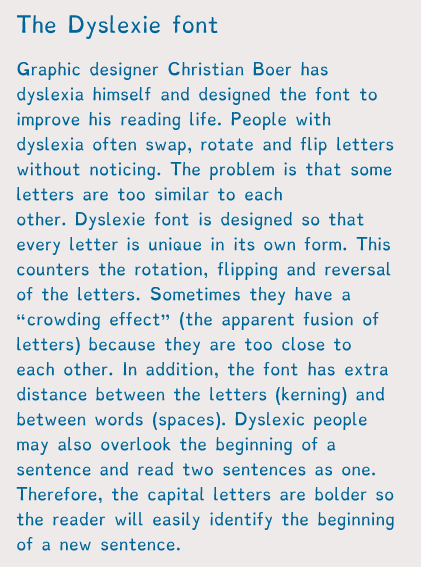
There’s also a dyslexic font designed especially for dyslexic people to read.

You can install on your tablets, laptops and browers etc, so not only can you change things like documents into it, you can change websites into that font as well! 

I’m sure you’re bright enough to do a google search, but since I’m dumb enough to forget to post a link, here it is. Better late than never

https://www.dyslexiefont.com/en/dyslexie-font/

I default to arial for this reason, but I will now be defaulting to verdana or dyslexie. nice.

Ok I have dyslexia and I didn’t know this. Thank you so much!!!!

This made me so happy!!!

Teaching things! Use this for your text components 😀