
Honestly something that bothers me more than most things is having my compassion mistaken for naivety.
I know that another fish might eat this bullfrog right after I spend months rehabilitating it.
I know that turning a beetle back onto its legs won’t save it from falling over again when I walk away.
I know that there is no cosmic reward waiting for my soul based on how many worms I pick off a hot sidewalk to put into the mud, or how many times I’ve helped a a raccoon climb out of a too-deep trashcan.
I know things suffer, and things struggle, and things die uselessly all day long. I’m young and idealistic, but I’m not literally a child. I would never judge another person for walking by an injured bird, for ignoring a worm, or for not really caring about the fate of a frog in a pond full of, y’know, plenty of other frogs.
There is nothing wrong with that.
But I cannot cannot cannot look at something struggling and ignore it if I may have the power to help.
There is so much bad stuff in this world so far beyond my control, that I take comfort in the smallest, most thankless tasks. It’s a relief to say “I can help you in this moment,” even though they don’t understand.
I don’t need a devil’s advocate to tell me another fish probably ate that frog when I let it go, or that the raccoon probably ended up trapped in another dumpster the next night.
I know!!!! I know!!!!!!! But today I had the power to help! So I did! And it made me happy!
So just leave me alone alright thank u!!!!
THIS.
I heard a story about this, a parable I guess.
There was a big storm and a ton of starfish were washed onto the beach, stranded much further up than they could get back and beginning to bake in the post-storm sunshine. A little girl was walking down the beach, picking up starfish and throwing them back into the sea. Some guy comes up and asks her what she’s doing. “Saving the starfish,” she says.
He looks around at the huge beach and the hundreds of starfish, and says “You can’t possibly save them all. I’m afraid you’re not gonna make much of a difference.”
She throws another starfish back into the ocean, and replies “It made a difference to that one.”
Yeah, I mean, we know we can’t change all the things. But have you ever noticed how much better life is when you’re around people who change things when they can?
Kindness is a choice. Even if it’s small, it’s worth it.
This is what I’m talking about, when I say that kindness and compassion do not equate with ignorance, stupidity, or naivety. Being cynical does not make someone more intelligent or more worldly.
Kindness is not weakness.
Kindness is brave. Especially when you also know that your kindness might not be returned, may even be met with anger or cruelty. It’s reaching out with an open hand, knowing that it’s just as likely to be bitten as it is to be held.
Kindness is hard. If you can’t find it in yourself to be kind, then fine. But don’t make it more difficult for those that can.
“
All I ever do is try to empty the sea with this teaspoon; all I can do is keep trying to empty the sea with this teaspoon.”
–
Melissa McEwan
Coping Skills
So, if you’re willing to help a friend out, I’ve realised something.
When I am at max capacity, and I cannot continue functioning at the current level of ability, I can do one of two things:I can fall into a nonepileptic seizure
or
I can shut one or more functions down, to conserve energyThe easiest ‘function’ for me to shut down is speaking. I’ve been doing it for years, and it’s quite helpful in surviving overwhelming situations. Most recently it helped me finish grocery shopping without having a panic attack, which was super useful.
BUT
If I do this, it then leaves room for an unintended but unfortunate consequence: Nobody can converse with me. So, my husband and I picked up small, key phrases in American Sign Language so that I can still communicate back, but I don’t have to speak. It’s quicker than typing something on a screen, and I can still portray emotion fluidly and get my point across effectively as long as I’m understood.
So if you’re a friend, and you’re local, consider watching some videos on ASL. You don’t necessarily have to practice the gesticulations, but if you know the words I’m going to be using with my hands and body, it’ll help us all carry on a conversation when my voice needs a break.
And then, I won’t feel left out! 🙂
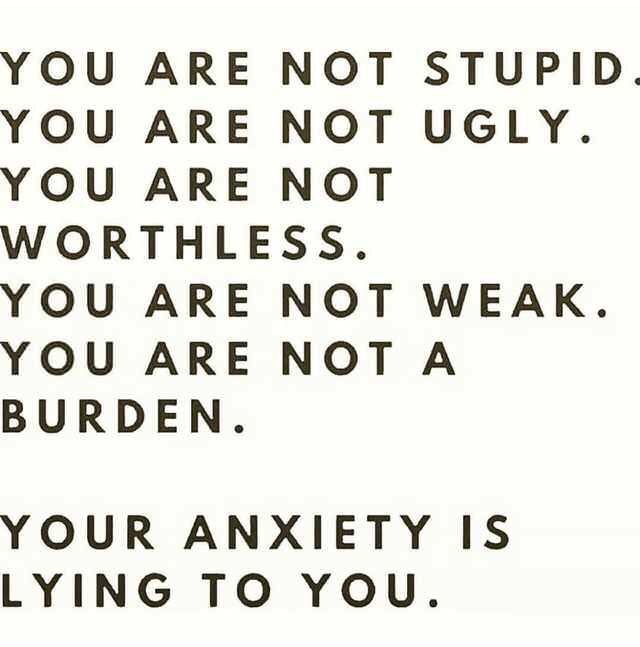
You are not stupid.
You are not ugly.
You are not worthless.
You are not weak.
You are not a burden.Your anxiety is lying to you.







mythology moodboards | loki & sigyn
“i’ll carry your world.”
for @nestha, from your @femmefatalenet secret santa
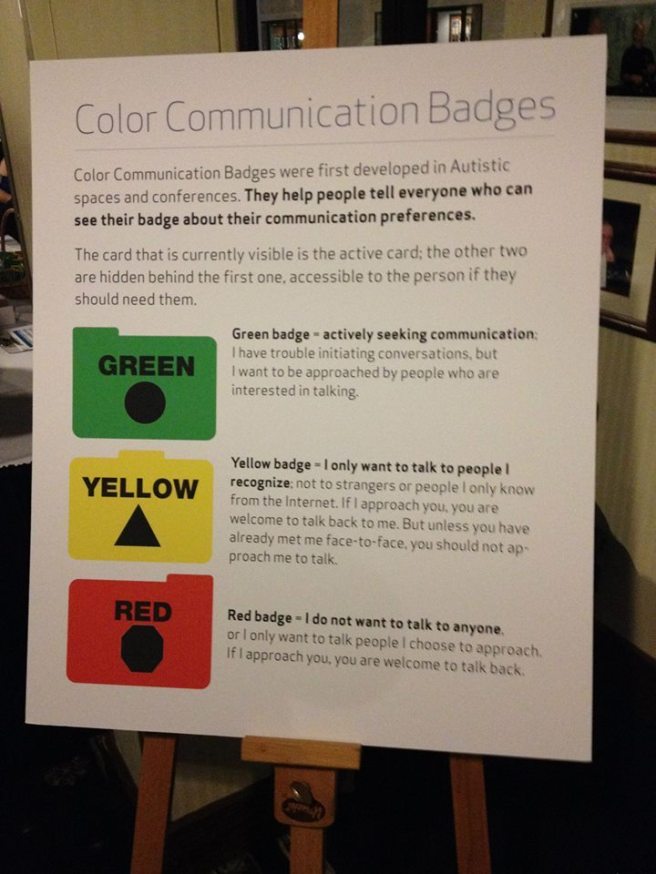
[Image is a poster explaining briefly the origin and meaning of green, yellow, and red interaction signal badges, referred to above as Color Communication Badges.]
CAN WE DO THESE AT CONS
SECONDED.
if youre not autistic or suffer from an actual disorder, dont use these. its not cute.er… you know a lot of autistic people go to conventions, right? And people with social anxiety disorders and panic disorders? Shit if I could get away with using this at work I would.
Hello there, justsjwthings.
I would like to introduce myself. I refer to myself as Sam Thomas, though my legal name and how a lot of people know me is Matthew. I am officially diagnosed autistic.
Over one week in June 2013 (last summer), I was in Washington, DC for an autism conference called the Autism Campus Inclusion (ACI) summer leadership program run by the Autistic Self-Advocacy Network for autistic college students.
If you have any question as to the truth of this, I would like to direct your attention to this YouTube video that ASAN produced promoting the above-mentioned conference. I appear as the first person in the video and you can find more images of my face on my blog.
At this conference, not only did we use these communication badges pictured above, but we actually had the opportunity to meet Jim Sinclair, the inventor of these badges.
During the part of the conference in which Jim Sinclair gave us a history of Autism Network International (ANI)—which they were a co-founder of—they talked to us about the establishment of this particular piece of assistive technology. Basically, it was a simple idea that seemed to fit a need and quickly became very popular among many autistic spaces for it’s practicality and ease of use.
The conference it originated from is called Autreat and is held annually by ANI. This is an autism conference that accepts Autistics and Cousins (ACs)—that is, anyone diagnosed or otherwise self-identifying with any disorder autistic or similar that may share a number of autistic traits.
There was a need. The need was met. This is how we can safely assume most technology either emerges or becomes popular.
We also talked about something called Universal Design and the Curb-Cutter Effect. The Curb-Cutter Effect is when something to fit a specific need is found to create convenience in a broader area than intended. Curb cuts allowing for wheelchair accessibility to sidewalks proved to also be convenient to anyone who may have trouble with steps or even simply a mother with a baby stroller or maybe a child with a wagon. This is a desirable outcome with disability rights advocacy as creating convenience for non-disabled people often makes the assistive technology easier to advocate for.
In this sense, these colored communication badges could serve that Curb-Cutter effect. Not only would this be perfectly acceptable for non-disabled people to use for convenience, but would also help to increase their effectiveness and convenience for those of us who need them. Here are a few examples:
- Increased popularity makes the colored communication badges more easily recognizable to the general public, making them as effective outside the above-mentioned autism conferences as inside.
- Increase in demand would create increase in supply and availability, likely making these available to pretty much anyone and even being included with, say, the name tags you are required to wear at most cons.
- In addition to these helping people recognize the communication state of the wearer, the wearer will be able to recognize whom they can feel more comfortable to approach.
- Increased popularity would make these badges more acceptable for public use and less alienating to those who would wear them frequently.
This is not something that we are completely incapable of surviving without; this is something that was convenient and made our lives a lot easier. If that can be easily shared with the general public, then what purpose does it serve not to share it?
Thank you for reading.


Spoonie and other chronic illness health reminder of the day: if all you can manage to make or eat today is “junk” food, then good job, you fed yourself. That’s the main thing. You need calories, your body needs them for energy, and you deserve to eat them, however you manage to get them. I know it’s not always ideal, but sometimes you just gotta eat.
So sick and tired of seeing “it’s really simple to eat your way healthy” posts, especially from other people with chronic health conditions who should know better. Yes, Susan, I know how simple and easy it is to make nourishing bone broth, but are you also going to stand in my kitchen for 8 hours while it simmers, do everything else I need to do today, then strain it out, clean up everything and feed it to me too? Oh you managed to make huge batches of it while you had energy and are now able to pull it out of the freezer? Well aren’t you profoundly lucky to be able to do that.
Stop shitting on people who can’t.
And if I see anymore of y’all posting “honestly people who don’t even try to eat healthily deserve to stay sick” posts I’m going to climb out of your garbage disposal like Truth hauling ass out of her well and smack you with your own ladle, so help me gods.
Stop it. You should know better than this. It’s a fucking fucked up fact that “good” food is a luxury for a lot of sick and disabled people, who are often under employed or relying on welfare to survive. It is so absolutely fucked up that not everyone can afford fresh groceries every week or has the means to cook them. But don’t you dare try to imply it’s because they’re not trying hard enough and deserve to be sick. What the fuck is wrong with you. Go sit in the corner.
I’m done spoon feeding you human decency for the day.

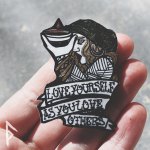

Sigyn and Loki pins with enameling that got reserved before I listed them, but I will probably make more. 🙂
Sigyn: “Love yourself as you love others.”
Loki: “Without chaos there is no creation.”
to ADHD students:
• I’m proud of you. The education system works against us at every turn but you’re still hanging in there, and that’s amazing.
• Long term goals are lovely but they won’t motivate you. ADHD brains know two times: now and not now. Long term goals fall under “not now”, so if you try to use them to motivate yourself your brain won’t buy it. Some things that help me get motivated: using coloured pens, bringing a tasty drink like juice or pop to my desk, playing music I can sing along to.
• Get. Diagnosed. With an official diagnosis, you can access accommodations through your school. You don’t have to struggle through school being held to neurotypical standards. You can get things like extra time on tests, extensions on assignments, access to digital copies of textbooks so you can use text-to-speech software, the ability to write tests and exams in a smaller room with fewer distractions, noise cancelling headphones during tests. I live in Ontario so I can’t guarantee all of these things in other places, but you’ll never know what accommodations are available to you until you apply for them.
• Work for the amount of time that you can. You can only handle five minutes? Do work for those five minutes. You can stretch it out to fifteen minutes today? Awesome! It’s excruciating for us to get work done without it being a crisis, I know. But doing work in small increments every day goes a long way. Doing nothing because you can’t work as long as a neurotypical is just going to leave you with more work to do the night before.
• Keep fidgets and/or stim toys at your desk. If you get overwhelmed or can’t focus, grab a fidget and allow yourself to just sit and fidget for a little bit. Tactile stim toys are my favourite since they’re very grounding for me.
• Try not to beat yourself up for what you didn’t get done earlier. This is a hard one but it’s so so hard to get anything done while you’re upset with yourself, especially for us ADHDers who get easily caught up in emotions. You have a disability. It’s not your fault that you couldn’t get it done earlier. You’re working on it now and that’s what’s important.
 Holding the Bowl