For the uninformed, functioning labels are terms like high functioning autism, low functioning autism, mild autism, severe autism. Other words like moderate or level 1, level 2, etc may be used too.
Functioning labels are extremely offensive because they’re placed on autistic people based on observation from the outside. This is problematic for three reasons.
Functioning labels determine how autistic people are treated. People associate “low functioning/severe” with incompetence or infancy and they end up treating the autistic person like a pet or a baby. High functioning/mild gets stereotyped as people who are just a little quirky and their difficulties get ignored as laziness or intentional stubbornness.
Functioning labels imply brokenness and treat people as if their intrinsic value is determined by what they contribute to society rather than the fact that they are a living being with oxygen in their lungs and blood in their veins like everybody else.
Functioning labels create a dichotomy as if there are differing “levels” of autism or that people exist on different areas of the spectrum. NO, NO, NO, that’s not how it is.
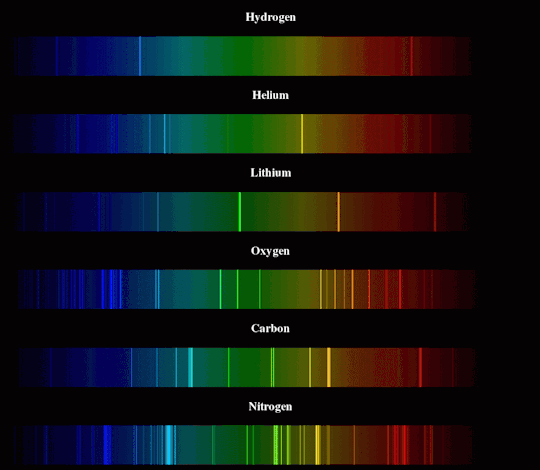
Think of spectroscopy and how the elements create their own signature color lines. Now put peoples’ names in place of the elements: Hydrogen/Harold, Helium/Henry, Lithium/Luke, Oxygen/Olga, Carbon/Carol, Nitrogen/Nadine.
Autism is like that. We’re all on the same spectrum and all that is unique is how we display our symptoms, our sensory issues, our splinter abilities and so forth.
In light of that, I want to change the language. Let’s start pushing for support levels instead of functioning labels.
High support: Anyone who isn’t able to live independently and needs help with some or all of their basic daily living skills such as eating, bathing, basic grooming, putting on makeup, getting dressed and completing tasks. Can be abbreviated online or in writing as HSP for High Support Person or HSAP for High Support Autistic Person.
Usage in speech: Clarissa is a high support autistic person and needs assistance with getting dressed and taking a shower. Abbreviated usage online: I’m a HSAP and I’m really into physics, so the poor sucker who signs me on is gonna hear a lot about it when they hand me my iPad!
Medium support: Anyone may or may not live independently and doesn’t need help with basic living skills, but needs help with other things like cooking, completing some tasks, transportation if unable to drive and assistance for things like grocery shopping. Can be abbreviated online or in writing as MSP for Medium Support Person or MSAP for Medium Support Autistic Person.
Usage in speech: Kevin is a medium support autistic person and needs some assistance to prepare meals and shop for the wood he uses for his carpentry projects. His boyfriend, Max, usually helps him with those. Usage online: I’m a MSAP and I’m looking for info about saws. Any fellow auties know what’s best for cutting oak?
Low support: Anyone who more often than not lives independently and may only need assistance with minor things like balancing a checkbook, getting started on some tasks like organizing a garage sale or arranging to move from one house to another. Can be abbreviated online or in writing as LSP for Low Support Person or LSAP for Low Support Autistic Person.
Usage in speech: Jesse is a low support autistic person and she only needs help keeping her checkbook balanced. Usage online: I’m a LSAP and I’m thinking about moving to Seattle. What’s the weather and traffic like there?
Reasons support levels are better:
They don’t make assumptions about intelligence
They don’t encourage infantilization or pity
They sound more respectful and dignified
Ditch functioning labels and start using support levels. These terms can apply to practically every kind of disability, not just autism.
For the record, I’m a MSAP.
Please reblog this whether you’re disabled or not. Make this viral.
My DMs have an overarching theme this week. So, for anyone who needs to
hear it: you are not beyond help. You are not a lost cause.
If you want to make a change, you can. The change may not be as dramatic
as you’d like—hell, it may not be immediately visible, but you can do
it. No matter where you are.
Comparing yourself or your progress to other people can hurt you. Your
progress is good, and it should be celebrated, no matter where you are
or where you started from.
It may feel like bailing out a sinking boat with a teaspoon, but as
you’re bailing, your movements are propelling your boat to shore. You’ll
get there.
Be kind to yourselves. Your effort matters. You are not hopeless. You are worth the work.
(This is all about digging yourself out of a mess. You can interpret that literally or metaphorically. It’s true either way.)
“Aren’t schizophrenic people dangerous-” No. Violence towards other people isn’t a symptom of schizophrenia, nor is it common in schizophrenic people. That’s not to say that no one with schizophrenia has ever been violent because of their psychosis, but it isn’t a symptom of or in the diagnostic criteria for the illness, and schizophrenic people in general are no more likely to be violent than anyone else.
“Isn’t that when you have multiple personalities-” No. Schizophrenia isn’t about having multiple personalities – that’s called Dissociative Identity Disorder and is a completely different mental illness. Schizophrenic people might hear one or more voices in their heads and may feel like their actions or thoughts are being controlled by other people/outside forces, but this isn’t the same as having several personalities as it’s always the schizophrenic persons own personality which reacts to these distressing experiences.
“Isn’t schizophrenia when you’re psychotic like when you hear voices and stuff-” Yes, but schizophrenia isn’t “just” about experiencing psychosis (hallucinations, disorganized thinking/speech/behavior and delusions), it also consists of what’s called negative symptoms (lack of energy, lack of motivation, social isolation, lacking or inappropriate emotional responses, lack of ability to feel pleasure) and cognitive symptoms (impaired memory, impaired concentration, learning difficulties, executive dysfunction and impaired working memory). Schizophrenia is a complex mental illness and psychosis is only 1/3 of what schizophrenic people struggle with.
“You can’t recover from schizophrenia, right-” Not true. 25% of the people diagnosed with schizophrenia are symptom free within 5-10 years of being diagnosed with the illness and up to 80% improve with ongoing treatment and support. Schizophrenia isn’t necessarily a life sentence, and while you can’t EXPECT to recover from schizophrenia and while there’s no known cure, recovery is possible for many people with the right treatment.
“Shouldn’t schizophrenic people be locked up-” No. Schizophrenic people are people just like everyone else, and we have the right to the same human rights and the same freedom as other people. We might need to be hospitalized for our own safety sometimes, but we have as much of a right to be a part of and interact with society as everyone else.
“Real schizophrenic people don’t know they’re sick, right-” Some don’t, but at least 45% of schizophrenics are aware that they’re suffering from schizophrenia, so a person being aware that they’re schizophrenic and having insight into their illness/knowing that what they’re experiencing isn’t real or normal isn’t a sign that they aren’t really sick.
“What if schizophrenic people just have special powers-” I’m not going to deny you your right to your spiritual beliefs, but I’m going to insist that you don’t force them onto me or any other schizophrenic person. Just like I’m not gonna show up at a Christians door saying that God isn’t real just because I’m an atheist, you don’t get to tell a schizophrenic person that they can see into other dimensions or talk to spirits. You risk triggering or worsening our illness by sharing your spiritual or religious speculations, so don’t bring them up. Ever.
“Aren’t schizophrenic people dangerous if they don’t take their meds-” No. Anti psychotic meds are heavy medication that impacts your life in many ways, and taking them should always be a free choice. Some people would rather live with their psychosis than take anti psychotic medication, and this doesn’t automatically make them a danger to anyone.
I would really appreciate if non schizophrenic people would consider boosting this post as schizophrenia is a very misunderstood and stigmatized mental illness and I want this post to show up on as many dashes as possible.
The next time somebody gives you shit about your late autism diagnosis, remember that Anthony Hopkins was diagnosed as autistic when he was 70 years old.
People can go almost their whole lives and never know they’re autistic, but recognize they feel different from their peers.
And BTW Anthony Hopkins stims by rubbing his hands together, and being autistic is exactly why he’s such a good actor. He studies people’s mannerisms with an analytical mind, adopts those mannerisms for characters and turns out awesome performances. He’s a chameleon.
^That. Your dx might not happen yet because of money or ridiculous ideas on the part of your doctors but if you know you’re very probably autistic, odds are good you are.
You’re in good company. We’ve got: Geeks, sporty people, actors, artists, great friends, business moguls, sketchbook doodlers, public speakers, asl experts, activists, cat snugglers, Knights of the UK, parents, kids, dinosaur experts, shoelace collectors, snorkleing enthusiasts, quilters, people with all kinds of bodies and faces and colors and lives.
I work in a public library and there are times a book comes through circulation that is so awesome I can’t believe I hadn’t seen it before.
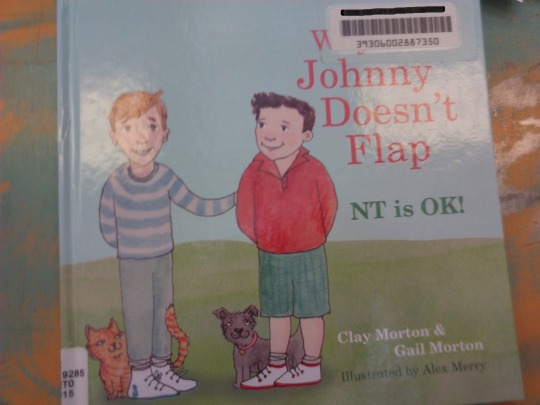
Last week I came across this lovely children’s picture book called Why Johnny Doesn’t Flap: NT is OK! by Clay Morton, Gail Morton, and illustrated by Alex Merry. (Pardon the library barcode covering part of the title here.)
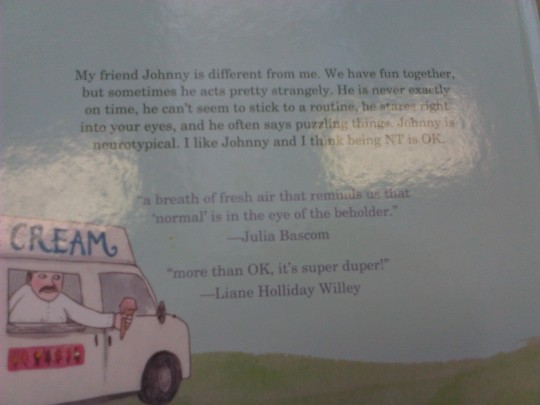
[Pictures of the front and back covers of the picture book. The back cover summary says: “My friend Johnny is different from me. We have fun together, but sometimes he acts pretty strangely. He is never exactly on time, he can;t seem to strict to a routine, he stares right into your eyes, and he often says puzzling things. Johnny is neurotypical. I like Johnny and I think being NT is OK.”]
The fact that I was seeing the term “NT” on the cover of a children’s book was enough to pique my interest. Upon further inspection, I discovered that the book is really quite lovely!
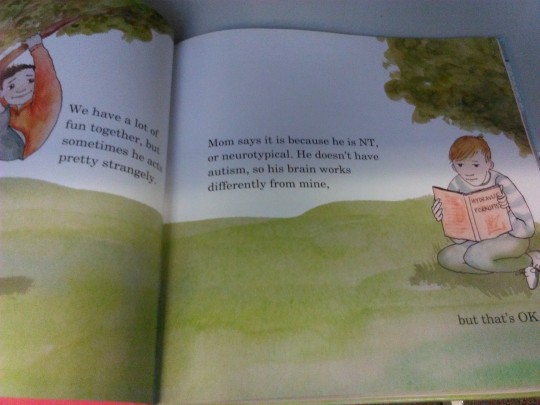
[Two page spread reads: “We have a lot of fun together, but sometimes he acts pretty strangely. Mom says it is because he is NT, or neurotypical. He doesn’t have autism, so his brain works differently from mine, but that’s OK.”]
It flips the typical “little Timmy has a special friend” narrative on its head. Instead, the narrator is an autistic boy who has an NT friend who he sometimes struggles to understand.
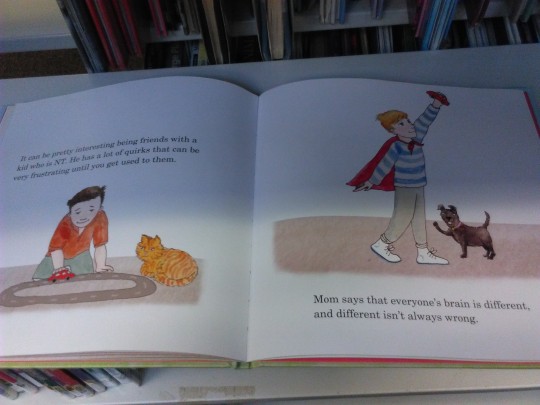
[Two page spread reads: It can be pretty interesting being friends with a kid who is NT. He has a lot of quirks that can be very frustrating until you get used to them. Mom says that everyone’s brain is different and different isn’t always wrong.”]
The book uses simple terms to describe a perspective not usually seen in any literature, let alone lit intended for children.
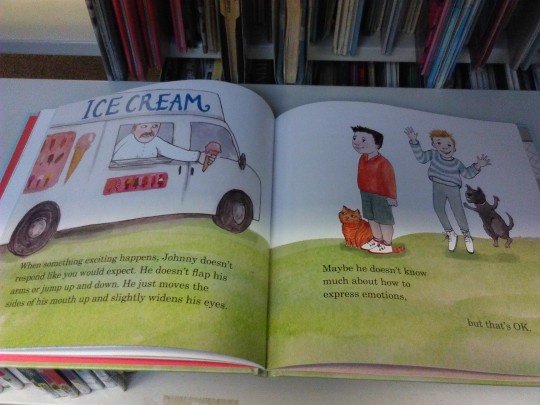
[Two page spread reads: “When something exciting happens, Johnny doesn’t respond like you would expect. He doesn’t flap his arms or jump up and down. He just moves the sides of his mouth up and slightly widens his eyes. Maybe he doesn’t know much about how to express emotions.”]
I think ultimately this flipping of the narrative is more effective in getting the message across that kids with autism are just like everyone else but with unique needs.
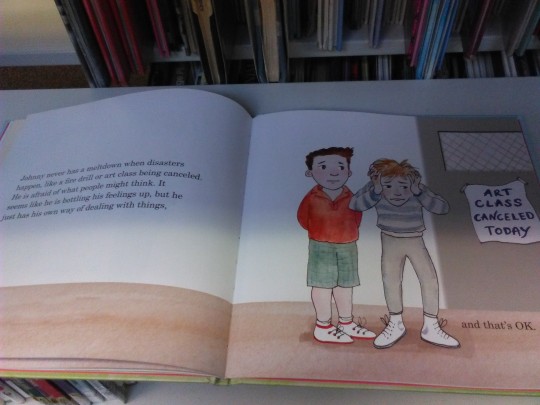
[Two page spread reads: “Johnny never has a meltdown when disasters happen, like a fire drill or art class being canceled. He is afraid of what people might think. It seems like he is bottling his feelings up, but he just has his own way of dealing with things, and that’s OK.”]
And this book is something autistic kids don’t usually have– it’s a book from their perspective! And it’s a non-offensive, matter-of-fact perspective, which is all the rarer.
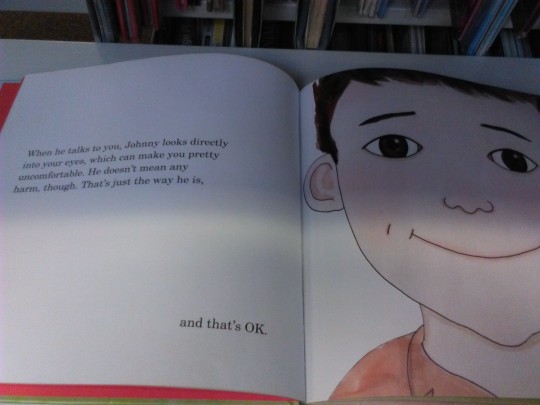
[Two pages spread reads: “When he talks to you, Johnny looks directly into your eyes, which can make you pretty uncomfortable. He doesn’t mean any harm, though. That’s just the way he is, and that’s OK.”]
It talks about things that autistic people experience and can relate to.
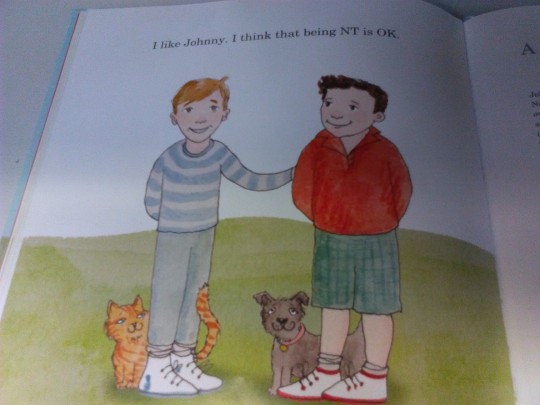
[Page reads: “I like Johnny. I think that being NT is OK.”]
How awesome is that?
OK this is kind of adorable and I kind of want it.
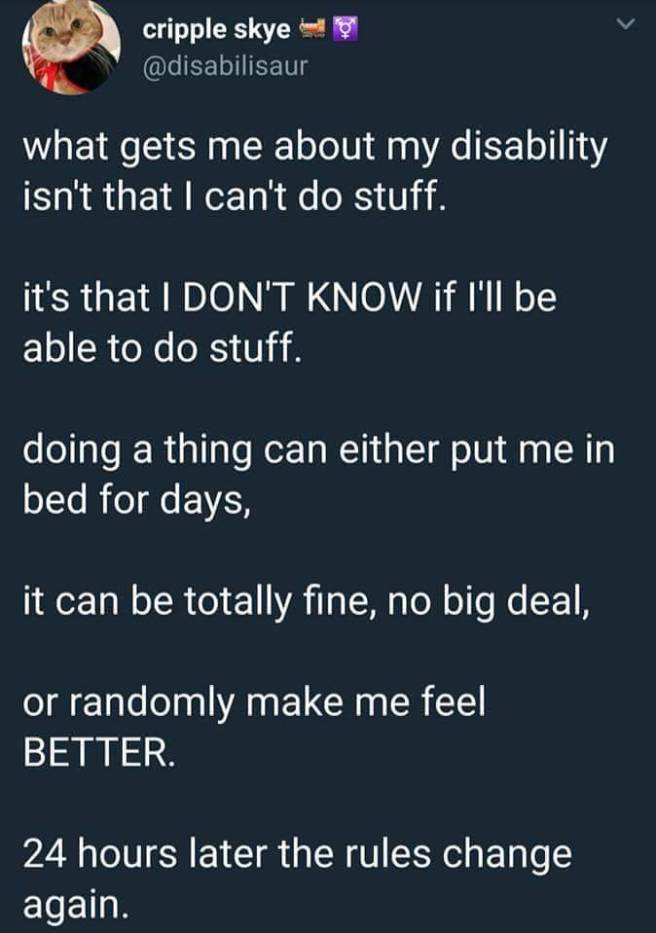
Casual reminder that disabilities are often based on the day or the unique challenges of the situation. People who need a wheelchair on most days might not on one particular day. People who use an emotional support animal may not need it 24/7. People who rely on canes may only need it when they’re having bad days. It doesn’t mean they’re faking of their disability isn’t valid. Energy levels and pain fluctuate and that’s okay.
Enfold me again, in white feather warmth Blossom scented Sigyn, Delicate, as the slightest breeze Yet with Audhumlas’ nurturing strength. You, whose sweet song Guides me to Ginnungapaps’ balmy heart Where I find You dancing, Free as a bird. Your laughter is joyful. You are sweetness, my goddesss You, a young girl, Rambling through Your garden of herbs. You, an older girl, Drawing the heart of the…




 Holding the Bowl