When I am feeling like focusing on the spiritual, particular the Divine I’ve always been in tune with Loki in terms of energy: I’m a chaotic kind of person; I tend to change quickly and without warning (part of being in parts manic and depressive); I believe myself to be a thing of fire and of blood and the moon and all things that shift.
Sometimes the sheer endless chaos of the universe (and my life) is overwhelming and I sink into that cacophony. I have a tendency to lose track of the every day important things when I get obsessed with the novel and the exciting – even if that’s in a negative way like focusing on the ways my depression or mania are manifesting. Work, relationships, my own health (mental and physical) get lost in the whirlwind. I sleep all day, missing appointments, avoiding commitments, then stay up way too late reading and writing and thinking at a mile a minute.
Reading about and meditating on Sigyn is a good way of grounding myself: reminding myself that stability isn’t weakness and that sometimes the mundane requires attention so that the creative and cerebral – art and the pursuit of new knowledge and experience – can be explored more efficiently. So thank you Sigyn for manifesting tonight, letting me find your book again and showing yourself and your spirit in the kindness and care of the people who care about me. You hold the bowl and keep the chaos at bay: our Lady of the blessed mundane, the foundational baseline to the harmonies of the turmultuous universe.
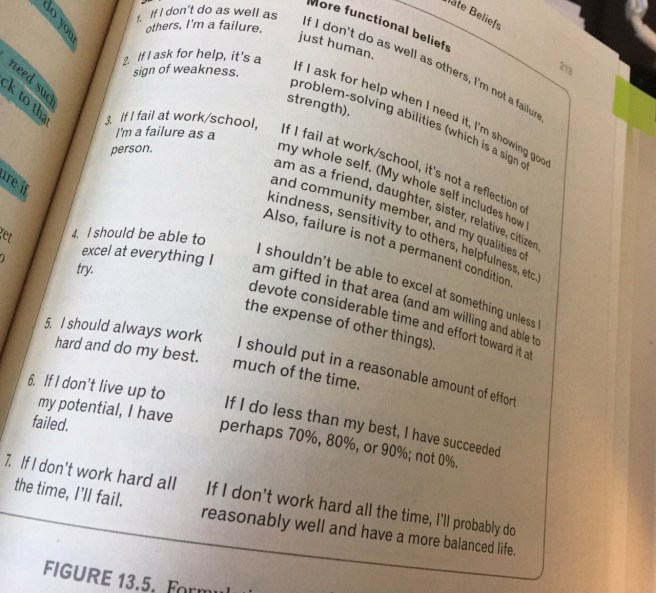
This is a really helpful page in my CBT textbook for tackling some of the maladaptive beliefs we often hold. The first column lists the rules and assumptions we often may tell ourselves, while the second column is a more functional belief. Just thought I would pass this along. Be kind to yourselves, friends❤
Oh my god, number 5. And 6, and 7.
I frigging needed that.
Failure is not a permanent condition.
The text on the image:
Maladaptive belief:
If I don’t do as well as others, I’m a failure. More functional belief:
If I don’t do as well as others, I’m not a failure, just human.
Maladaptive belief: If I ask for help, it’s a sign of weakness. More functional belief: If I ask for help when I need it, I’m showing good problem-solving abilities (which is a sign of strength).
Maladaptive belief: If I fail at work/school, I’m a failure as a person. More functional belief:
If I fail at work/school, it’s not a reflection of my whole self. (My whole self includes how I am as a friend, daughter, sister, relative, citizen, and community member, and my qualities of kindness, sensitivity to others, helpfulness, etc.) Also, failure is not a permanent condition.
Maladaptive belief: I should be able to excel at everything I try. More functional belief: I shouldn’t be able to excel at something unless I am gifted in that area (and am willing and able to devote considerable time and effort toward it at the expense of other things.
Maladaptive belief: I should always work hard and do my best. More functional belief: I should put in a reasonable amount of effort much of the time.
Maladaptive belief: If I don’t live up to my potential, I have failed. More functional belief: If I do less than my best, I have succeeded perhaps 70%, 80%, or 90%; not 0%.
Maladaptive belief: If I don’t work hard all the time, I’ll fail. More functional belief:
If I don’t work hard all the time, I’ll probably do reasonably well and have a more balanced life.


 Holding the Bowl