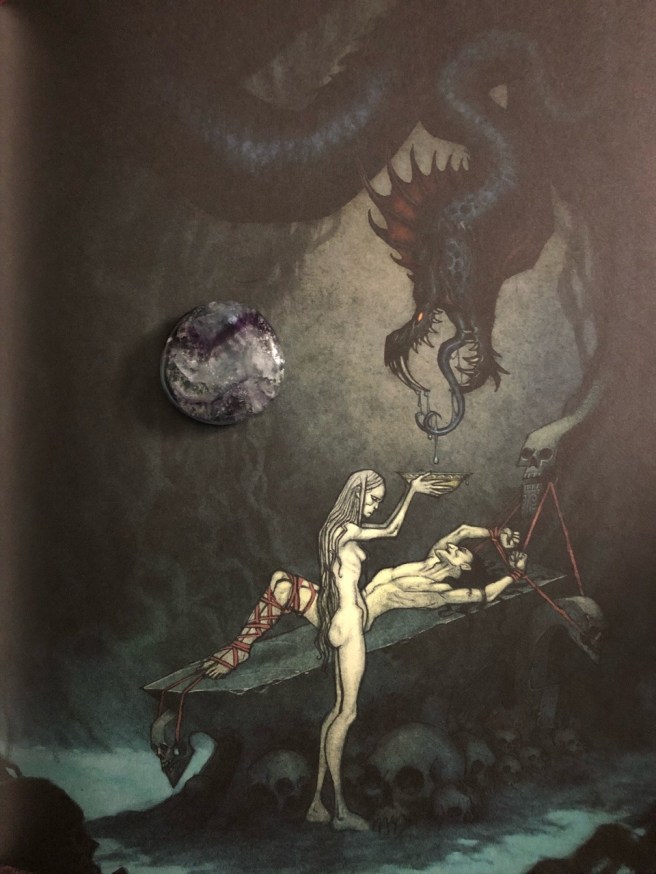
So why did Sigyn not simply dump the bowl, flip it upside down, and stick it on Loki’s idiot head? The poison would slide down the side and away from his eyes…
Myths are myths, not entirely literal accounts of what’s going on in a
literal cave on some other plane. They’re stories that allow us to
grasp otherwise inexpressible truths, and as such they work on a number
of different levels. It’s not always about what makes the most rational
or least painful story.
One one level, this story was an
explanation for why there are earthquakes. We’re talking about Iceland,
where there’s a lot of geological activity. Since the earth was said to
tremble from Loki writhing in pain, it would kind of defeat the point if
he never had to deal with the poison.
In a narrative sense, you have to remember that the Aesir want Loki tortured. That’s why Sigyn and Loki are in this predicament. There are theoretically a lot of things she could do or build to stop the poison drip, but the Aesir probably wouldn’t let that slide. The only reason they put up with the bowl thing may well be that she’s actively suffering for it too.
The torture also helps to justify why Loki fights against the Aesir at
Ragnarok, since let’s face it, you need some pretty hardcore motives to
actively fight to end the world.
But on a deeper level, the
myth isn’t really talking about snakes or bowls or chains. It’s about
concepts like order and chaos, betrayal and loyalty, suffering and
mercy. If the myth were different–if Loki didn’t have to be bound, or
Sigyn didn’t have to make the same sacrifice–then it wouldn’t reflect
those deeper truths.
So, this illustration is really powerful to me. I can’t stop looking at it. I’m struggling not to cry, and clutching this stone that I associated with Sigyn just this morning . It conveys so much of their agony. It hurts me.
Illustration of Sigyn and Loki by John Egerkrans in the book Norse Gods.
Okay, I have to say a thing: Can I just… I’m literally trying not to cry. Someone abusive in my past was obsessed with Sigyn, but reduced her, like Marvel, to a nitwit who blindly loved Loki regardless of transgressions and emotional abuse, as she so often idolized with so many of the relationships she sought to imitate and force onto her… targets. This, I feel, brings so much more life to the Goddess of Fidelity . The agony in this illustration. You do not blindly do this shit for someone you don’t truly care for. True Fidelity must be earned, not gained through tricks. Blind faith in abusers is sickness and dependency, not fidelity and loyalty. Fidelity and loyalty is earned through hard work and built upon trust. Trusting a trickster sounds foolish, but you don’t eternally hold a bowl to save your lover as best you can from agony without them truly deserving it. I’m not saying much on Loki here, aside from I believe he is a god of change, not evil, or malice, or any of the other cruel insults wrought in misunderstanding. People who fear the change, and the other, and the odd might call it evil, but it’s a necessary part of life. The cycle of life, death, and rebirth. You can try to hold it off as long as you can, but the rot that forms will be worse than the cleansing fire of change. This is the principle I live by.
Researchers have found a genetic mutation that links Ehlers-Danlos Syndrome (#EDS), Postural Orthostatic Tachycardia Syndrome (#POTS), and Mast Cell Activation Syndrome (#MCAS) http://ow.ly/2FcO30i8IrR
So in rereading Krasskova’s Sigyn devotional for the first time in a few years, I have to say I’m pretty happy with how far my understanding of Sigyn has come since I first looked at it.
To the point where I can say, without much doubt, that Krasskova frankly just gets some shit wrong.
She praises Sigyn for not expecting praise for “doing what needs to be done without complaint, without boasting” and, while I think that’s true and fair to an extent (you don’t get cookies for being a decent person or doing decent things), I think if you take it too far you start to fall back into this sexist ideal of the “doormat mother/wife figure who bends over backwards for her family with a smile and without complaint and never expects anything in return”.
For a few years now I’ve been exploring the idea of Sigyn as someone who starts out as so utterly selfless/so without self-worth that she would literally lay down her life for her loved ones and brushes off praise and love as something she either a) doesn’t deserve or b) doesn’t want because she’s just “doing what she should be”.
And honestly, it’s just… it’s not a healthy way to be. Even for a goddess. Even for a goddess as implacable and strong as a mountain.
Which, I think, is where Loke comes into the picture.
He makes her feel safe enough to be selfish, to expect something for the things she does, to listen to her when she’s heartbroken or furious or bitter or joyous, he lets her be the child she never had a chance to be.
Just as Sigyn gave Loke inangard, the sacred enclosure of the home, Loke gave Sigyn a sacred enclosure in his arms to be everything we don’t want women and mothers and wives to be: unlikable, demanding, vocal in their complaints and wants, and recognition that the things they do matter.
Sigyn watched her family be torn apart and defied Odin to stay by Loke’s side through his torture. I think she’s earned a little right to be able to show her emotions and expect some kind of reward.
Don’t burn yourself alive just to keep someone else warm. Or if you’re gonna do it, make sure they damn well know about and appreciate it.
Here’s a thought I had about how therapy & treatment works (vs how many people imagine it works). This is based on my experience with depression and chronic illness, but I hope it applies more broadly as well.
Imagine you have to take a road trip on a deserted road alone. Halfway through the trip your engine starts to splutter and the car breaks down. What do you do?
A lot of people imagine that therapy and treatment is like calling a mechanic to come and fix your car for you. You make the call, and then you just have to wait around until the mechanic has fixed the problem, and your car is good as new! Unfortunately, it doesn’t work like that. There is no on-call mechanic. No-one is able to fix this car except for you.
Instead, it’s like you pull a toolbox out of the trunk, pop open the hood, and dial up the mechanic on the phone. You have to try and describe the problems as clearly as possible, and follow the advice they give you as well as you can.
Sometimes you won’t understand the advice, and you’ll need them to explain it again or suggest something else. Sometimes you’ll do what they say and the car still won’t run, and they won’t be able to explain why, only give you something new to try. Sometimes you’ll think you fixed the problem and start driving, and the car will break again two minutes down the road. No matter what happens, it’s going to be hard and messy and frustrating work.
But at the end of it, not only will your car be running again, but you’ll know how to fix it now. Which isn’t to say that you’ll never need another mechanic again, but next time you get stuck, it’ll be that little bit easier to handle.
So keep at it everyone, and good luck on your journeys!
My first batch of
lavender wine made my lips go numb after a single sip. I shared it with
other heathens and they found it quite strong also. So of course the
next time I had a crop of lavender from my garden, I made lavender
vodka.
Your periodic reminder that in people who have been subject to threats and punishment for having emotional responses or ‘inappropriate’ facial expressions, panic attacks look different.
They may look like the person has become calmer and less involved, dismissive, even. Some people become intensely subservient and silent. Some become catatonic.
Panic doesn’t always involve screaming, crying, and obvious signs of distress. It involves an extreme form of the person’s fear response – which can be altered by circumstance, ability, and what they’ve learnt to fear.
Which is to say, it’s not your place to decide someone isn’t having a panic attack, when they’ve told you that’s what’s happening.
Yes, absolutely this. I get quiet and withdrawn when I’m having a panic attack. A quiet panic attack is still a panic attack.
It me.
I tend to have “slow moving” panic attacks. Like it slowly takes over my body and brain. But it ends with me very shut down, except for my brain, which is endlessly looping.
Free Review Copy For the First Historical Romance with a Disabled Protagonist (Spina Bifida)!
This is the first historical romance from a big publisher with a disabled protagonist! You might remember me talking about the first book in the series – The Importance of Being Scandalous (it’s 99cts atm!), in which Julia, the character with spina bifida, was a side character. It’s a companion series with separate stories, so you don’t need to have read the first book to read this.
Now she’s getting her own book and it’s vital that we support it to show we want diverse books! You can help by talking about the book, reblogging this post – or you might get an early copy if you request one:
for special requests about other involvement (promo etc) email publicist Holly at holly@entangledpublishing.com with details about your social media.
Who qualifies:
Everyone who can leave a review on Goodreads/Amazon/Their Blog. You don’t need to have a book blog.
The release date is January 30th. Reviews posted by then would help the most, but there’s no deadline.
Full blurb:
Jasper De Vere doesn’t do sad. Ever since the death of his parents, he’s devoted himself to life’s many pleasures—while making sure to avoid attachments. It’s difficult to avoid your own grandfather though, especially when you’re the heir to his Dukedom. Unable to sit by and watch one of the few people he cares about wither away, Jasper flees to his friend Nicholas’s country estate.
Julia Bishop leads a life of glorious excitement—in her head. The spinal injury she was born with makes her a permanent pariah in society, so despite being the daughter of an earl, she’s spent her life in the country with just her family to keep her company. When her brother-in-law’s flirtatious—and devilishly handsome—friend mistakes her for an untroubled debutante, Julia isn’t about to let an opportunity for some real, live adventure slip away.
Delicious distraction and flirtation turn into an all-out affair, and slips dangerously close to something more when family intrudes. Can Jasper and Julia return to their separate lives in isolation, or will they take a risk and choose each other?
I got my period completely unexpectedly. I hadn’t even been told a thing about it and was absolutely convinced something was wrong with me when I saw blood in my panties. I had to go, crying and scared, to my teacher. I had to sit, embarrassed and bloody, in the office and wait for my stepmom.
I was 9
The blood was thick, heavy, and I felt like I was going to throw up. My stomach rejected food, the part of my body I wasn’t even fully aware of yet was now always sticky and wet and gross and I was told it was completely and totally natural. No one told me it was okay to be afraid. No one prepared me.
“It’ll be over in a few days,” they said.
“It won’t come back until next month,” they said.
I was 10
Sleep started to elude me almost completely, and then I’d get so tired that my father had to literally drag me into a standing position so I’d start to become conscious. My stepmom didn’t explain that if my pad got full I could change it. She yelled at me because pads are expensive. I ruined almost all of my underwear because I didn’t want her to yell at me again. My dad refused to acknowledge it had happened at all. He has four daughters.
I was 11
A sharp pain gripped my side and I could barely breathe. I didn’t feel good. I begged to stay home from school. I was crying and clutching my side. Something wasn’t right.
“It’s normal,” they said.
“Don’t be so dramatic,” they said.
I passed out in science class. Woke up in the doctor’s office because my small town didn’t have a hospital and was told I’d had a ruptured ovarian cyst. I had four more cysts on my left one and at least three on my right. I needed to be on birth control and tested for PCOS.
I didn’t even know what an ovary was.
I was 12
My dad flat out refused to get me birth control. Said I didn’t need it. That there was no reason for a twelve year old to get on the pill. I’d just start having sex and who knows what else and that was that.
He’s a nurse.
I was 13
“What do you mean you’ve gone through the entire box of pads already?” my stepmother demanded, loud, shrieking. “There were 20 pads in there! How many days do you bleed?”
I didn’t know I was supposed to count.
“When does your period start? How many days between stop and start?”
I didn’t know I could count.
I started marking it all on my calendar. Some months there was nothing. Some months over half the days were filled in. I stole an entire box of pads from under the sink to hide in my room for my very own.
I was 14
New year, new calendar. I give my period tracking one to my stepmom and take her through it page by page. My periods last 10 days at the least. There is no consistent day my period begins and I show her.
“You just counted wrong,” she says.
I was 15
My legs swell. My back aches. I’ve got a headache. I puke up my dinner and shit out my breakfast five minutes after I ate it. I’ve bled all over my bed.
“You’re overreacting,” they said
“Don’t be such a baby,” they said
I was 16
I can’t eat for two straight days because if I do I will throw up. I’m not sick. I’m on my period.
It’s normal, I think.
I’m 17
I go through 40 pads this time.
It’s normal, I think.
I’m 18
I gained three pant sizes right before the blood shows up. I lay in bed all day with a heating pad across my shoulder blades, on my lower back, and one across my stomach. It doesn’t really help.
It’s normal, I think.
I’m 19
My own money. No health insurance. I moved away. Saw a doctor. I’m on birth control pills.
I’m 20
The pills have stopped working at easing my blood flow. The doctor tries a new pill. It does nothing. The doctor tries another pill. I can’t afford it. I don’t go to the doctor for four more years.
I’m 24
My girlfriend drags me to the doctor with my state health insurance. She tells the doctor about my symptoms. The doctor’s mouth opens slightly.
“That’s not normal,” she says.
I bleed for 28 days straight.
I’m diagnosed with Polycystic Ovarian Syndrome. The doctor asks if I want an IUD. I’ve never even heard of that.
My insurance pays for it. It’s free.
“Okay,” I say.
“It’s worth a try,” I say.
I haven’t had a period in months.
I am 25
My oncologist examines my medication list. “IUD? Birth control?” he asks. “You’re married. Don’t you want kids?” No. “What about your husband.” Wife. “Oh.”
My GP is out of town. I see a new doctor. We’re discussing surgeries. Is a hysterectomy an option?
“No,” he says. “You might marry a man who wants kids.” I’m married to a woman and I don’t want kids.
My dad is a nurse. He has four daughters.
“You’re married to a woman. Why are you on birth control?”
“Because I need to be,” I say. Finally. I say. “Because I want to be.”



 Holding the Bowl