Devotional blog dedicated to the Goddess Sigyn offering support to those who are "holding the bowl" within difficult relationships.
Author: Sephira
Born and raised primarily in Northern Virginia, my family and I moved to North Carolina in 2006. Married for over 20 years, my husband and I have two boys and a gaggle of cats.
For me, writing is a great stress reliever. I can let my mind wander and let my emotions run free in a way that is generally not possible in my normal everyday life. My writings run the gamut in terms of style and genre – for instance my first novel is a historical romance set in the Civil War, but some of the other things I have in the works are fantasy or thrillers, among other things.
It probably goes without saying, but my poetry is somewhat eclectic in nature, and again while some may feel the need to stick with a particular form, I tend to write just whatever comes to mind. Let the winds of inspiration lead me on…
I’m always interested in comments and feedback. So please feel free to share your thoughts with me!
I realized a little while ago (after struggling with mental illness for almost 30 years) that my approach needs to be positive, not negative.
I don’t mean positive thinking or any of that shit. I mean, if you’re mentally ill, you often frame management as “an absence of symptoms.” Which is great, if you’re talking about acne or a torn ACL or chicken pox. But if your mental illness is as pervasive as mine (anxiety with obsessional features), striving to eliminate every single symptom so that you can be “normal” is a fool’s errand. And I used to get worked up about it. One of my future in-laws likes to comment on my knee bouncing, and it wrecked my self-confidence whenever we were over at their house. “Nervous tic?” she’d ask, in front of everyone.
My current therapist is great. When I talk to her about eliminating a certain habit or tic that I have, she asks me if that tic is interfering with me living the life I want. If the answer is “yes,” then we work on eliminating it. If the answer is “no,” then we leave it be. My anxiety makes it impossible for me to go to Disneyworld. But I don’t want to go to Disneyworld, so there’s no reason for me to worry about it. I could spend all of my time trying to control all of my rituals and tics. I could exert all of my energy into social situations and “pushing my limits,” but all that is going to do is make me miserable.
Let’s reframe health as “capable of living the best life you can.”
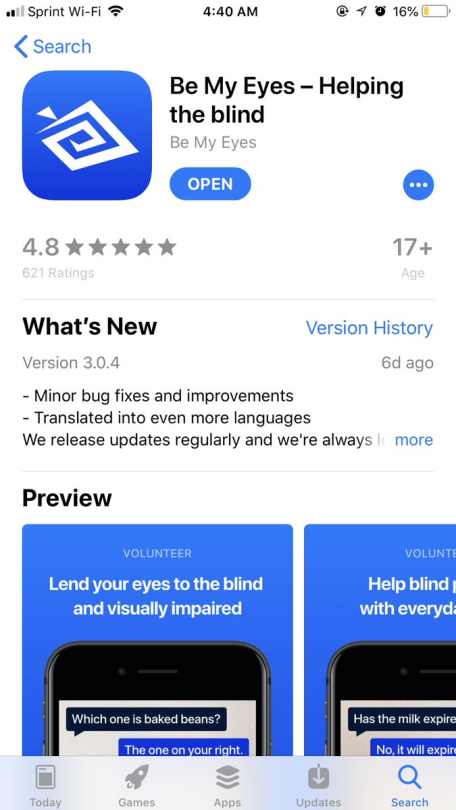
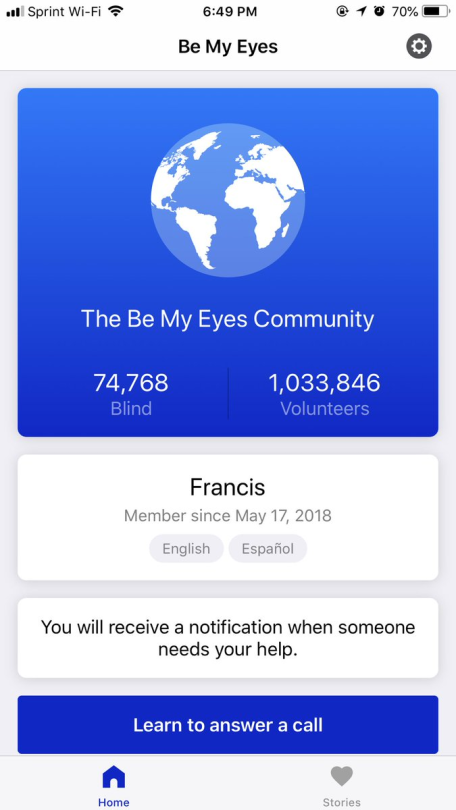
The app is called Be My Eyes and allows blind people to phone or message for help. The app seems to allow video and photos to be sent and the sighted person on the other end can send a message to the blind person, answering whatever inquiry they have.
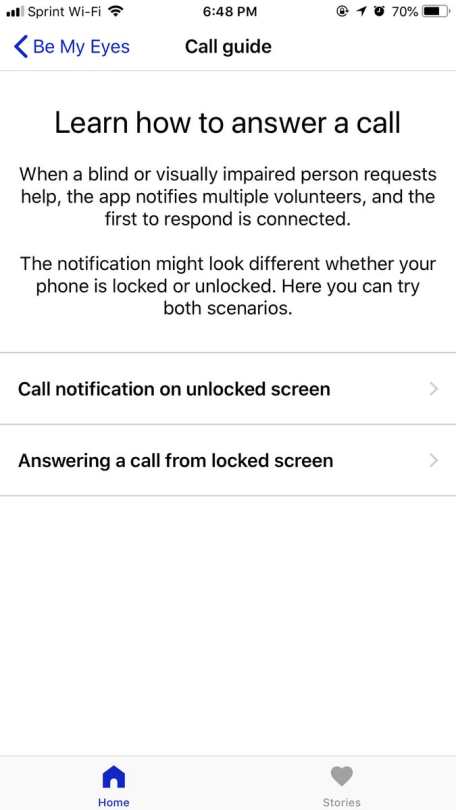
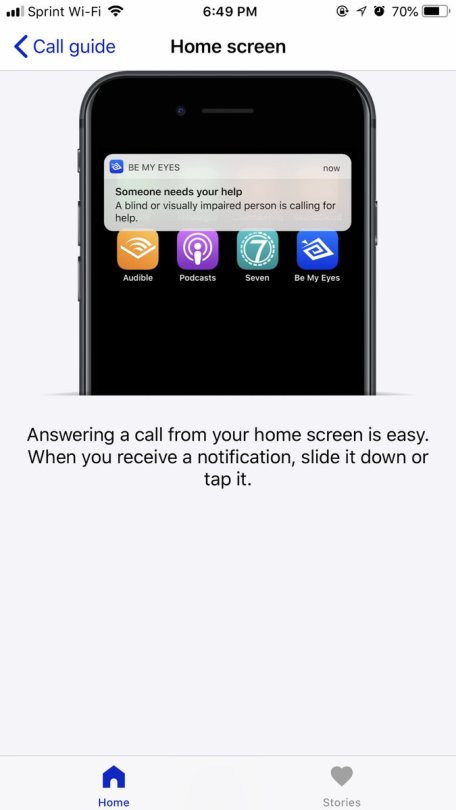
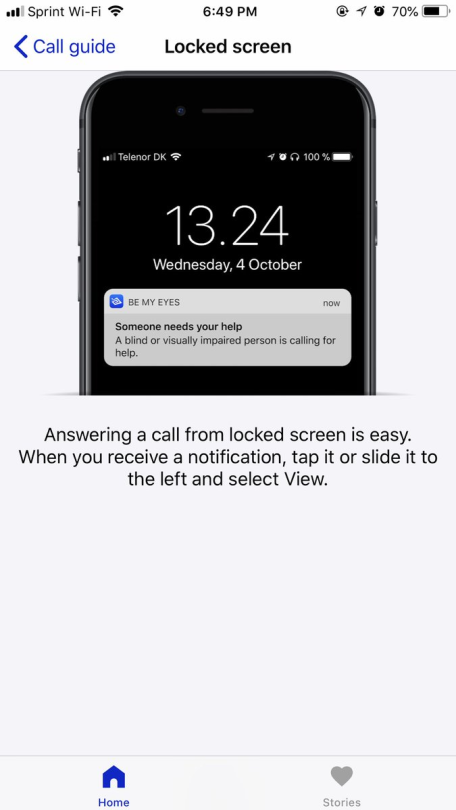
[This is a set of screenshots about the app called Be My Eyes.
First photo: The overview page for the app. The top says “Be My Eyes- helping the blind.”
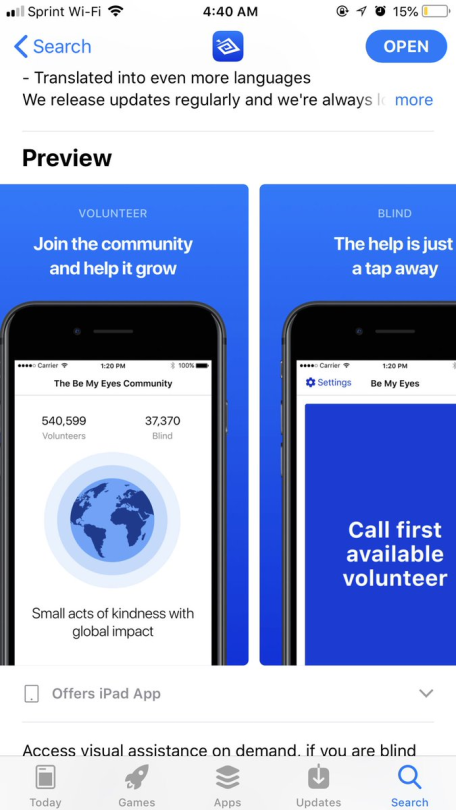
Second photo: The preview page on the app store. It shows two phones. The one on the left is titled “Volunteer” and says “Join the community and help it grow.” The one on the right is titled “Blind.” The phone under the title has “Call first available volunteer,” written in large font.
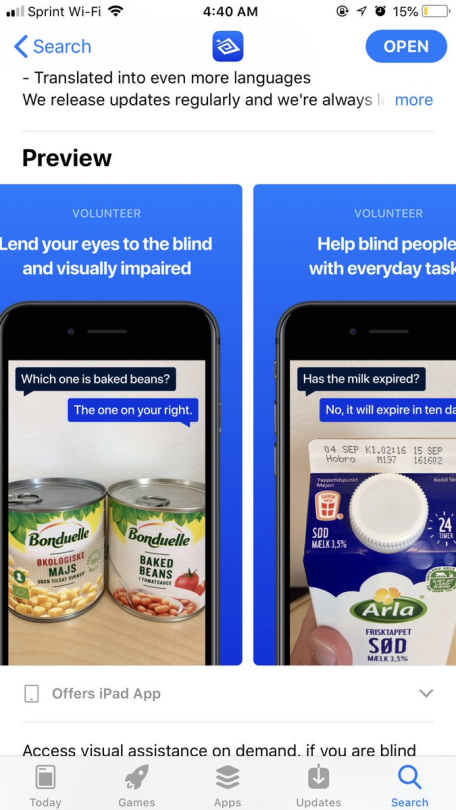
Third photo: More previews. Shows the messages between two people texting each other. The visually impaired person sent a picture of two cans of food, and is asking which one is beans. Another example shows the person sending a picture of their milk carton, and asking if it is expired.
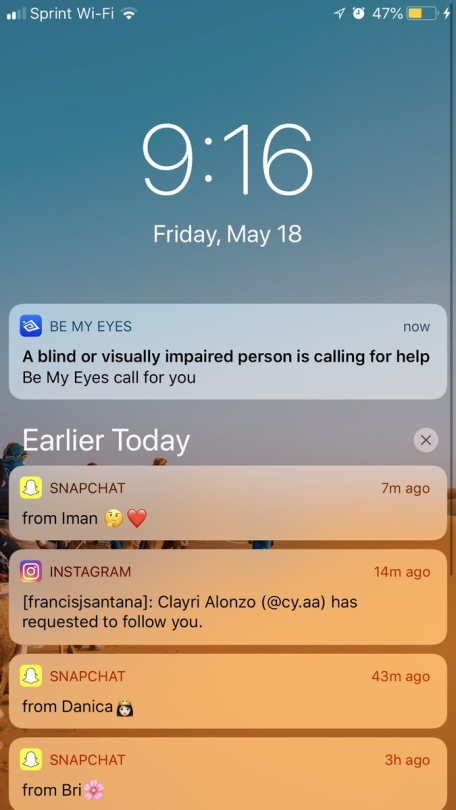
Fourth photo: An iphone lock screen. A notification from the app says “a blind or visually impaired person is calling for help.”
Fifth photo: The profile page of a sighted user named Francis, who speaks English and Español. The top says there are 74,768 Blind and 1,033,846 Volunteers using the app.
Sixth photo: Text that says “Learn how to answer a call. When a blind or visually impaired person requests help, the app notifies multiple volunteers, and the first to respond is connected. The notification might look different whether your phone is locked or unlocked. Here you can try both scenarios.
Seventh photo: A notification from the app on an iphone home screen. The instructions say to pull the notification down or tap it to answer a call.
Eighth photo: The same notification on an iphone lock screen. The instructions say to tap it or slide it to answer the call.]
Please reblog the version of this post with image descriptions. It’s a service for blind folks, posted about in a format blind folks don’t have access to (without the descriptions).
Also, if you’re willing to download and use this app but you don’t go out of your way to add image descriptions to the images you share, please reevaluate that! Contact me if you need help adding image descriptions to things.
This app is actually very useful. The way sighted people are talking about it is not.
Sigyn is sweet and lovely like a child just as much as She is a strong, fearless warrior. A peaceful warrior with a relentless spirit. Her victory lies in overcoming adversities, not escaping them. She inspires us to be strong and raise our consciousness beyond limiting beliefs, while at the same time staying open and vulnerable, so that we can forgive ourselves and others, and thus be truly free.
“We are all peaceful warriors in training – learning to live with a peaceful heart and a warrior’s spirit.” (Dan Millman)
Sigyn knows the meaning of suffering very well, yet She consciously chooses not to be a victim of it, not to let it bring Her down. She does not complain and She does not hold bitterness. She forgives, She has compassion, hope and patience.
A quick note to all my (amazing) able-bodied allies: be careful when talking about the “curb cut effect” in relation to how accessibility affects people. When you mention “prams, buggies, and bicycles” in the same breath as people with mobility aids, you’re conflating “accessibility” with “convenience”.
When disabled people talk about accessibility, we’re talking about “equal access” not “ease of access”. When something isn’t accessible, we’re not mildly inconvenienced; we’re completely excluded. When the lift isn’t working, we can’t get to work. When public transportation isn’t accessible, we’re not troubled; we’re trapped.
This is why our most vocal supporters call themselves “disability rights activists” not “accessibility advocates”. It’s not about the benefits of accessibility; it’s about the direct, long-term harm a lack of accessibility causes.
Most folks don’t realize that the ADA is not a building code, but is in fact a civil rights law. So, the next time you’re explaining how important accessibility is to your able-bodied friends, don’t just focus on how accessibility makes the most common spaces better for everyone.
Focus on how a lack of accessibility excludes disabled people from even the most common spaces.
When I married the King’s brother, I didn’t know what would happen. How could I?
I understood he had children with another woman—but she was elsewhere and they weren’t mine to raise. I understood he was blood-tied into our people—but he was the brother of King, and it was the King himself who approved our marriage. It was good for alliances, after all, but it wasn’t political for me. I did love him. I won’t ever deny that. How could I deny him after all this time? To deny him would be to deny myself. To deny the parts of my truths that have come to define me—though I never saw it coming.
I loved him and that was the beginning of everything.
When we married in Asgard, the sun was the colour of hay when it’s first stacked, yellowed and streaked with bluegreen, like the sky managed to touch it this time instead of the other way around. I remember the smell of magnolia on the air and it rained, a little sunshower, just for a few minutes. I remember feeling like a dragonfly who’d finally found her wings. He was the citrine to my amethyst. I loved my hardluck lover the way people love an underdog and I always cared for strays but he was the one I took home. I loved him under that sun and it’s the same sun that still shines now, after all this time.
How to explain a beginning you can’t find, other than this moment?
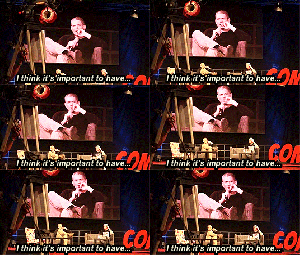
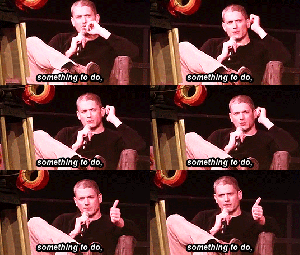
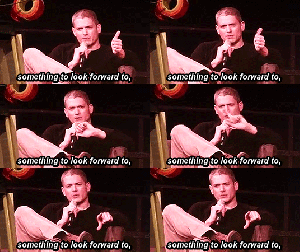
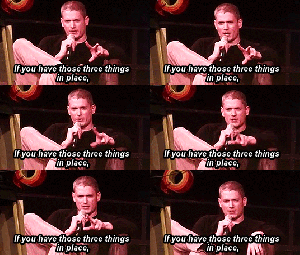
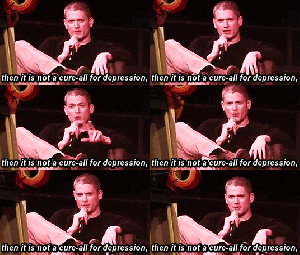
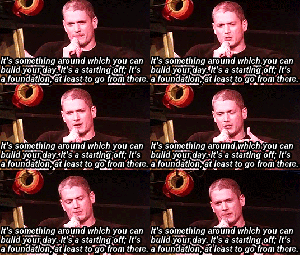
“I know you used to be depressed for a long time, and I want to know what your motivation was to change something to not live that way anymore?”
“I think it’s important to have something to do, something to look forward to, and something to love. If you have those three things in place, then…it is not a cure-all for depression…it’s not a cure-all for mental health issues…but it’s a place to hang your hat. It’s something around which you can build your day. It’s a starting off; it’s a foundation, at least…to go from there.”
– Wentworth Miller at German Comic con, 09. 12. 2017.
This is remarkably good, sharp and both funny, sad, righteous-angering and, well, eye-opening. It’s for the blind and partially-sighted, and just as much it’s for those of us who have never had to think about any of this stuff, and is called “10 Steps to Help You Find the Perfect Job”.




 Holding the Bowl