

Author: Sephira
Born and raised primarily in Northern Virginia, my family and I moved to North Carolina in 2006. Married for over 20 years, my husband and I have two boys and a gaggle of cats.
For me, writing is a great stress reliever. I can let my mind wander and let my emotions run free in a way that is generally not possible in my normal everyday life. My writings run the gamut in terms of style and genre – for instance my first novel is a historical romance set in the Civil War, but some of the other things I have in the works are fantasy or thrillers, among other things.
It probably goes without saying, but my poetry is somewhat eclectic in nature, and again while some may feel the need to stick with a particular form, I tend to write just whatever comes to mind. Let the winds of inspiration lead me on…
I’m always interested in comments and feedback. So please feel free to share your thoughts with me!
Helping those with autism find employment
A foreign language stood between Joe Obergfell and a high school diploma. Obergfell, who was diagnosed with autism at age 8, knew that language wasn’t his forte.
But Mooresville High required students to pass at least one language class for graduation. A counselor intervened, and Obergfell was allowed to fulfill the requirement with a programming class.
For Obergfell, the decision was life-changing….
If you know someone who’s depressed, please resolve to never ask them why. Depression isn’t a straightforward response to a bad situation; depression just is, like the weather. Try to understand the blackness, lethargy, hopelessness, and loneliness they’re going through. Be there for them when they come through the other side.
It’s hard to be a friend to someone who’s depressed, but it’s one of the kindest, noblest, and best things you’ll ever do.
Stephen Fry (via onlinecounsellingcollege)
» Soulmates Have Worst Relationships – Psych Central News
Provocative new research looks into the way that people think and talk about love.
Social psychologists observed that people talk and think about love in an incessant variety of ways but underlying such diversity are some common themes that frame how we think about relationships.
One popular perspective considers love as perfect unity (“made for each other,” “she’s my other half”); in another view, love is a journey (“look how far we’ve come,” “we’ve been through all these things together”).
These two ways of thinking about relationships are particularly interesting because, according to study authors Spike W. S. Lee and Norbert Schwarz, they have the power to highlight or downplay the damaging effect of conflicts on relationship evaluation….

Stress tied to change in children’s gene expression related to emotion regulation, physical health
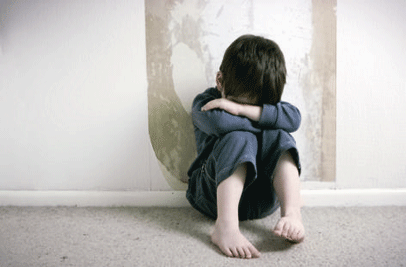
Children who have been abused or neglected early in life are at risk for developing both emotional and physical health problems. In a new study, scientists have found that maltreatment affects the way genes are activated, which has implications for children’s long-term development. Previous studies focused on how a particular child’s individual characteristics and genetics interacted with that child’s experiences in an effort to understand how health problems emerge. In the new study, researchers were able to measure the degree to which genes were turned “on” or “off” through a biochemical process called methylation. This new technique reveals the ways that nurture changes nature—that is, how our social experiences can change the underlying biology of our genes.
The study, from researchers at the University of Wisconsin, Madison, appears in the journal Child Development. Nearly 1 million children in the United States are neglected or abused every year.
The researchers found an association between the kind of parenting children had and a particular gene (called the glucocorticoid receptor gene) that’s responsible for crucial aspects of social functioning and health. Not all genes are active at all times. DNA methylation is one of several biochemical mechanisms that cells use to control whether genes are turned on or off. The researchers examined DNA methylation in the blood of 56 children ages 11 to 14. Half of the children had been physically abused.
They found that compared to the children who hadn’t been maltreated, the maltreated children had increased methylation on several sites of the glucocorticoid receptor gene, also known as NR3C1, echoing the findings of earlier studies of rodents. In this study, the effect occurred on the section of the gene that’s critical for nerve growth factor, which is an important part of healthy brain development.
There were no differences in the genes that the children were born with, the study found; instead, the differences were seen in the extent to which the genes had been turned on or off. “This link between early life stress and changes in genes may uncover how early childhood experiences get under the skin and confer lifelong risk,” notes Seth D. Pollak, professor of psychology and pediatrics at the University of Wisconsin, Madison, who directed the study.
Previous studies have shown that children who have experienced physical abuse, sexual abuse, and neglect are more likely to develop mood, anxiety, and aggressive disorders, as well as to have problems regulating their emotions. These problems, in turn, can disrupt relationships and affect school performance. Maltreated children are also at risk for chronic health problems such as cardiac disease and cancer. The current study helps explain why these childhood experiences can affect health years later.
The gene identified by the researchers affects the hypothalamic-pituitary-adrenal (HPA) axis in rodents. Disruptions of this system in the brain would make it difficult for people to regulate their emotional behavior and stress levels. Circulating through the body in the blood, this gene affects the immune system, leaving individuals less able to fight off germs and more vulnerable to illnesses.
“Our finding that children who were physically maltreated display a specific change to the glucocorticoid receptor gene could explain why abused children have more emotional difficulties as they age,” according to Pollak. “They may have fewer glucocorticoid receptors in their brains, which would impair the brain’s stress-response system and result in problems regulating stress.”
The findings have implications for designing more effective interventions for children, especially since studies of animals indicate that the effects of poor parenting on gene methylation may be reversible if caregiving improves. The study also adds to what we know about how child maltreatment relates to changes in the body and mind, findings that were summarized recently in an SRCD Social Policy Report by Sara R. Jaffee and Cindy W. Christian.
being bullied, abused, scapegoated, and neglected in school crippled my brain’s reward mechanism. despite having responsible, supportive parents, i was permanently damaged by that experience. medicating my anxiety and depression helps a lot, but it will still always be there. bullying is a form of child abuse. emotional cruelty from authority figures is a form of child abuse. this shit is real.
a society that’s happy to sprain itself bending over backwards to make sure kids don’t see sex on tv is willing to accept kids’ minds being permanently scarred in school. i just don’t understand.
Games may ease depression, anxiety in players
Video games can be entertaining, but could they also help improve mental health?…
“A lot of them look exactly the same as games that someone could play just for fun. So they may have cartoon characters, they could have missions, but embedded in that game are treatment mechanisms,” said Tracy Dennis, Professor of Psychology at Hunter College.
Dennis designed one such game called Personal Zen. She says preliminary findings show after playing the game for 20 minutes the brain starts processing negative information differently.

10 Activities To Relax Your Child
Getting your child with special needs to relax and focus can be a difficult job. There are many situations in which our children need some help to settle down. Whether your child is excited by something fun and enjoyable or something scary and unfamiliar, a calming exercise may be needed to move on to the next routine or activity.
Each child responds differently to calming activities so it is helpful to come up with a range of activities and strategies that could be calming for your child.
Here are 10 activities to build into your child’s routine and environment, which can be calming and soothing.
1. Play quiet music
Choose music that is steady and generally mellow. Music has a natural ability to filter out noises and set the mood for the environment. If your child is out in a busy environment, try noise-cancelling headphones.
2. Create a small, quiet area for your child
Sometimes children need their own personal space where they can block out the extra noise and visual distractions. This could especially work if your child tries to escape his/her current environment if overwhelmed. Try something like a small tent or create a small book area in your home that your child can easily retreat to when it is time for them to have a break.
3. Deep breathing exercises
Practice slow breathing with your child. Model slow, deep breaths for your child to imitate. If need be, teach your child to trace his/her finger in the shape of a square or figure-8 to help pace their breather.
4. Try a little yoga
The combination of slow breathing, stretching, tensing of muscles and concentration to hold a position can be centering and calming. Introduce this to your child in a fun way, such as a children’s yoga program or a DVD.
5. Go for a walk with your child
Taking a walk can help to release some of the extra energy that has been building up in your child, especially if he/she needs a break from an activity. A change in scenery and fresh air is helpful.
6. Turn out the lights
There are times that a child could be sensitive to light. In some cases, if a child is stressed or overwhelmed, turning out the lights or going into a darkened space can help bring a sense of calm and security. If you are trying to settle your child in the evening, turn down the lights as the evening routine winds down.
7. Give a bear hug, squeeze or back rub
Be careful when approaching your children to give any type of pressure, especially if he/she is sensitive to touch or startles easily.
8. Sit in a rocking chair or swing
The slow, rhythmic movement can be soothing for your child. If your child is unsure about this, you can have him/her sit on your lap while you rock to settle them in.
9. Offer your child something to drink
A drink of water or juice can be cool your child down if he/she is overheated. In some cases, drinking from a straw is also helpful because of the sucking motion, which provides some sensory input through the mouth.
10. Look for clues from the past
Think back to activities that worked to soothe your child when he/she was an infant. Often you will find clues about new activities that could be a great calming activity for your child.
When Using These Activities
Keep in mind, there may not be one activity that always works for your child. Some activities will not come naturally to your child.
Introduce and practice these activities when your child before suggesting them in a tense moment. When possible, give your child some choice in what he/she would like to do as a calming activity. Choices could be given verbally but also through visuals, like a choice board.
If your child has sensory processing challenges, a more prescribed and guided approach may be helpful. Consult with an Occupational Therapist for a more thorough assessment and program suited for your child’s needs
 Holding the Bowl