
Author: Sephira
Born and raised primarily in Northern Virginia, my family and I moved to North Carolina in 2006. Married for over 20 years, my husband and I have two boys and a gaggle of cats.
For me, writing is a great stress reliever. I can let my mind wander and let my emotions run free in a way that is generally not possible in my normal everyday life. My writings run the gamut in terms of style and genre – for instance my first novel is a historical romance set in the Civil War, but some of the other things I have in the works are fantasy or thrillers, among other things.
It probably goes without saying, but my poetry is somewhat eclectic in nature, and again while some may feel the need to stick with a particular form, I tend to write just whatever comes to mind. Let the winds of inspiration lead me on…
I’m always interested in comments and feedback. So please feel free to share your thoughts with me!







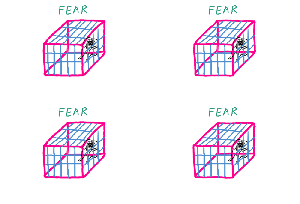

I found these gifs I made a while back for a site that’s not running anymore, so I thought I’d post them here. It’s a description of psychiatric symptoms and states of mind using a pink box and some other stuff.
Instead of Autism Speaks, consider:
- yodeling into a can of peas (although it is not helpful, its definitely not as harmful as A$)
My favorite thing about people who “don’t like Loki but love Sigyn” seem to not acknowledge that more often than not, the two are a package. Sigyn is more than aware of her husbands character, but I personally believe there’s a reason why they work so well.
Sigyn is vicious, Sigyn will be faster to the draw in cutting your neck open and sucking the blood out of you. And this is something multiple people have talked about. Sigyn isn’t you’re passive goddess, she isn’t your love and light here to balance Loki. She is a force to reckon with and I love her so much for it.




And then you realize that Forrest knows about his condition all along and your heart breaks a little.
a little?
A LITTLE?!Of course Forrest knows. That’s the whole point. His best “friend” spends his life calling him an idiot, people go around calling him an ~*~inspiration~*~ for living his life as usual, treating him condescendingly because they think he won’t know any different.
But he knows. Of course he knows. And he doesn’t have the words to say “fuck you all, I’m not my mental condition, I’m Forrest.”
I’d like to add that my uncle is mentally retarded (i.e. that’s his official diagnosis, it’s never been updated to “developmentally challenged” or whatever the most modern official language is) due to scarlet fever as a child and the first time he saw this movie, he cried. He’s not Forrest (although he has shaken hands with Jimmy Carter and met Ray Romano, and he held a single good job for 30 years before retiring from it), but Forrest was the first time in his entire life that he saw someone like himself onscreen.
My uncle was born in 1950 and became mentally disabled at the age of ten.
Forrest Gump came out in 1994.
After 34 years of isolation, being made fun of at work and shunned by neighbors, beaten up for being “weird” and whispered about in his community, my uncle—whose life dream was to become a preacher and who instead spray-painted locomotives for General Electric—saw someone else like himself. And he knew it.
He never read the book because he doesn’t have the mental capacity to read anything more complicated than a newspaper. When I told him there was a book—and that there’s a sequel to the book—he got really excited. Not because he could read it; not even because he’d be able to follow the story if I read it to him, but just because it exists.
There are Forrests among us. Don’t treat them the way this one was treated.
I promise you: they know.

What if Age Is Nothing but a Mind-Set?
One day in the fall of 1981, eight men in their 70s stepped out of a van in front of a converted monastery in New Hampshire. They shuffled forward, a few of them arthritically stooped, a couple with canes. Then they passed through the door and entered a time warp. Perry Como crooned on a vintage radio. Ed Sullivan welcomed guests on a black-and-white TV. Everything inside — including the books on the shelves and the magazines lying around — were designed to conjure 1959. This was to be the men’s home for five days as they participated in a radical experiment, cooked up by a young psychologist named Ellen Langer.
The subjects were in good health, but aging had left its mark. “This was before 75 was the new 55,” says Langer, who is 67 and the longest-serving professor of psychology at Harvard. Before arriving, the men were assessed on such measures as dexterity, grip strength, flexibility, hearing and vision, memory and cognition — probably the closest things the gerontologists of the time could come to the testable biomarkers of age. Langer predicted the numbers would be quite different after five days, when the subjects emerged from what was to be a fairly intense psychological intervention.
The men in the experimental group were told not merely to reminisce about this earlier era, but to inhabit it — to “make a psychological attempt to be the person they were 22 years ago,” she told me. “We have good reason to believe that if you are successful at this,” Langer told the men, “you will feel as you did in 1959.” From the time they walked through the doors, they were treated as if they were younger. The men were told that they would have to take their belongings upstairs themselves, even if they had to do it one shirt at a time.
Each day, as they discussed sports (Johnny Unitas and Wilt Chamberlain) or “current” events (the first U.S. satellite launch) or dissected the movie they just watched (“Anatomy of a Murder,” with Jimmy Stewart), they spoke about these late-‘50s artifacts and events in the present tense — one of Langer’s chief priming strategies. Nothing — no mirrors, no modern-day clothing, no photos except portraits of their much younger selves — spoiled the illusion that they had shaken off 22 years.
At the end of their stay, the men were tested again. On several measures, they outperformed a control group that came earlier to the monastery but didn’t imagine themselves back into the skin of their younger selves, though they were encouraged to reminisce. They were suppler, showed greater manual dexterity and sat taller — just as Langer had guessed. Perhaps most improbable, their sight improved. Independent judges said they looked younger. The experimental subjects, Langer told me, had “put their mind in an earlier time,” and their bodies went along for the ride.
Let’s get something straight.
Sigyn is not “Oh,Loki,I will always love you and you are never wrong!”
Sigyn is “Loki,I love you but what the fuck.”
Free DBT print-able workbook!
Pretty basic DBT skills workbook!
It’s kinda campy-looking, but I’ve found some stuff in it useful, and a lot of it mirrors the stuff we used in the DBT hospital I was in.
Attention Disorders Can Take a Toll on Marriage
Does your husband or wife constantly forget chores and lose track of the calendar? Do you sometimes feel that instead of living with a spouse, you’re raising another child?
Your marriage may be suffering from attention deficit hyperactivity disorder.
An A.D.H.D. marriage? It may sound like a punch line, but the idea that attention problems can take a toll on adult relationships is getting more attention from mental health experts. In a marriage, the common symptoms of the disorder — distraction, disorganization, forgetfulness — can easily be misinterpreted as laziness, selfishness, and a lack of love and concern.
Adults with attention disorders often learn coping skills to help them stay organized and focused at work, but experts say many of them struggle at home, where their tendency to become distracted is a constant source of conflict. Some research suggests that these adults are twice as likely to be divorced; another study found high levels of distress in 60 percent of marriages where one spouse had the disorder.

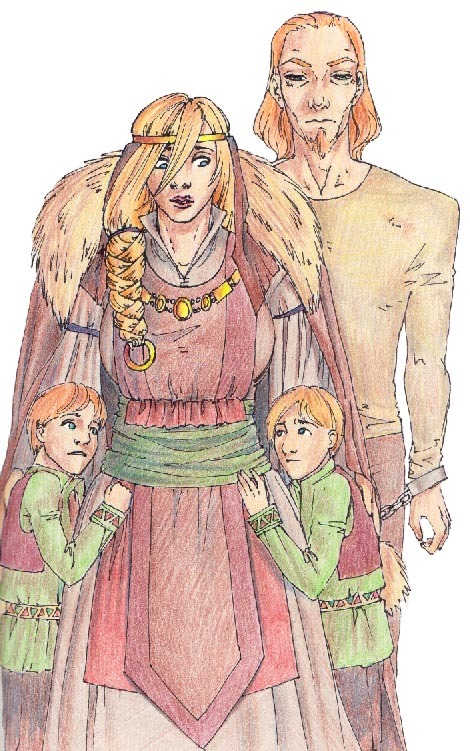
Saw this beautiful image of Loki and his wife Sigyn the other day and I cannot remember where! It really resonated with me and one day I’m hoping to print it and put it above my shrine.
 Holding the Bowl