
Thank you, Sigyn.
For giving me the strength to find the answer,
But not giving me the answer, yourself.
For comforting me in my sorrow,
and allowing me to find the truth myself.
Lastly, Thank you,
For not giving up hope on him, or on me.
Wellspring of Compassion.
Month: September 2014
I’m So Sorry My Daughter’s Disability Is Such An Inconvenience For You
If you think individuals and their families are just trying to game the system for their own benefit, think again….
I’m So Sorry My Daughter’s Disability Is Such An Inconvenience For You
1. Trauma permanently changes us.
This is the big, scary truth about trauma: there is no such thing as “getting over it.” The five stages of grief model marks universal stages in learning to accept loss, but the reality is in fact much bigger: a major life disruption leaves a new normal in its wake. There is no “back to the old me.” You are different now, full stop.
This is not a wholly negative thing. Healing from trauma can also mean finding new strength and joy. The goal of healing is not a papering-over of changes in an effort to preserve or present things as normal. It is to acknowledge and wear your new life — warts, wisdom, and all — with courage.
2. Presence is always better than distance.
There is a curious illusion that in times of crisis people “need space.” I don’t know where this assumption originated, but in my experience it is almost always false. Trauma is a disfiguring, lonely time even when surrounded in love; to suffer through trauma alone is unbearable. Do not assume others are reaching out, showing up, or covering all the bases.
It is a much lighter burden to say, “Thanks for your love, but please go away,” than to say, “I was hurting and no one cared for me.” If someone says they need space, respect that. Otherwise, err on the side of presence.
3. Healing is seasonal, not linear.
It is true that healing happens with time. But in the recovery wilderness, emotional healing looks less like a line and more like a wobbly figure-8. It’s perfectly common to get stuck in one stage for months, only to jump to another end entirely … only to find yourself back in the same old mud again next year.
Recovery lasts a long, long time. Expect seasons.
4. Surviving trauma takes “firefighters” and “builders.” Very few people are both.
This is a tough one. In times of crisis, we want our family, partner, or dearest friends to be everything for us. But surviving trauma requires at least two types of people: the crisis team — those friends who can drop everything and jump into the fray by your side, and the reconstruction crew — those whose calm, steady care will help nudge you out the door into regaining your footing in the world. In my experience, it is extremely rare for any individual to be both a firefighter and a builder. This is one reason why trauma is a lonely experience. Even if you share suffering with others, no one else will be able to fully walk the road with you the whole way.
A hard lesson of trauma is learning to forgive and love your partner, best friend, or family even when they fail at one of these roles. Conversely, one of the deepest joys is finding both kinds of companions beside you on the journey.
5. Grieving is social, and so is healing.
For as private a pain as trauma is, for all the healing that time and self-work will bring, we are wired for contact. Just as relationships can hurt us most deeply, it is only through relationship that we can be most fully healed.
It’s not easy to know what this looks like — can I trust casual acquaintances with my hurt? If my family is the source of trauma, can they also be the source of healing? How long until this friend walks away? Does communal prayer help or trivialize?
Seeking out shelter in one another requires tremendous courage, but it is a matter of life or paralysis. One way to start is to practice giving shelter to others.
6. Do not offer platitudes or comparisons. Do not, do not, do not.
“I’m so sorry you lost your son, we lost our dog last year … ” “At least it’s not as bad as … ” “You’ll be stronger when this is over.” “God works in all things for good!”
When a loved one is suffering, we want to comfort them. We offer assurances like the ones above when we don’t know what else to say. But from the inside, these often sting as clueless, careless, or just plain false.
Trauma is terrible. What we need in the aftermath is a friend who can swallow her own discomfort and fear, sit beside us, and just let it be terrible for a while.
7. Allow those suffering to tell their own stories.
Of course, someone who has suffered trauma may say, “This made me stronger,” or “I’m lucky it’s only (x) and not (z).” That is their prerogative. There is an enormous gulf between having someone else thrust his unsolicited or misapplied silver linings onto you, and discovering hope for one’s self. The story may ultimately sound very much like “God works in all things for good,” but there will be a galaxy of disfigurement and longing and disorientation in that confession. Give the person struggling through trauma the dignity of discovering and owning for himself where, and if, hope endures.
8. Love shows up in unexpected ways.
This is a mystifying pattern after trauma, particularly for those in broad community: some near-strangers reach out, some close friends fumble to express care. It’s natural for us to weight expressions of love differently: a Hallmark card, while unsatisfying if received from a dear friend, can be deeply touching coming from an old acquaintance.
Ultimately every gesture of love, regardless of the sender, becomes a step along the way to healing. If there are beatitudes for trauma, I’d say the first is, “Blessed are those who give love to anyone in times of hurt, regardless of how recently they’ve talked or awkwardly reconnected or visited cross-country or ignored each other on the metro.” It may not look like what you’d request or expect, but there will be days when surprise love will be the sweetest.
9. Whatever doesn’t kill you …
In 2011, after a publically humiliating year, comedian Conan O’Brien gave students at Dartmouth College the following warning:
“Nietzsche famously said, ‘Whatever doesn’t kill you makes you stronger.’ … What he failed to stress is that it almost kills you.”
Odd things show up after a serious loss and creep into every corner of life: insatiable anxiety in places that used to bring you joy, detachment or frustration towards your closest companions, a deep distrust of love or presence or vulnerability.There will be days when you feel like a quivering, cowardly shell of yourself, when despair yawns as a terrible chasm, when fear paralyzes any chance for pleasure. This is just a fight that has to be won, over and over and over again.
10. … Doesn’t kill you.
Living through trauma may teach you resilience. It may help sustain you and others in times of crisis down the road. It may prompt humility. It may make for deeper seasons of joy. It may even make you stronger.
It also may not.
In the end, the hope of life after trauma is simply that you have life after trauma. The days, in their weird and varied richness, go on. So will you.

It’s here. Chronic Illness and Education
Part 1 is all about going to school when you have a chronic illness. Thank you so much to Ali for putting this together. I hope you find this helpful, and th…It’s that time of year, everyone is dreading going back to school, especially when having a chronic illness can make everything ten times harder.
Check out all three videos:
Chronic Illness and Education Part 1 – School
Chronic Illness and Education Part 2 – Home Schooling
Chronic Illness and Education Part 3 – University
Also check out these links for posts about School and University
My wonderful Spoonie little pseudo-sister, thefaultinourspoons, put together this great post for out school bound Spoonies — please give it a look! It’s fantastic, as usual!! 💙




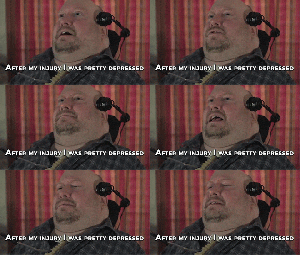

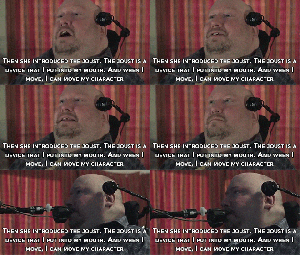
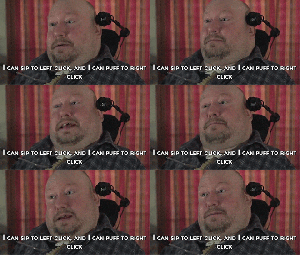

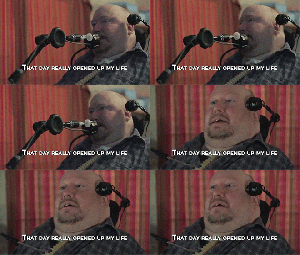
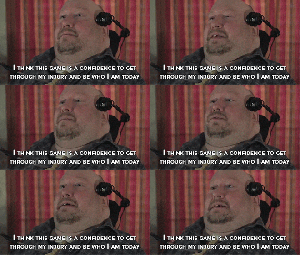

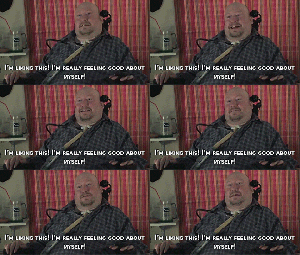
Watch the inspirational video of this quadriplegic who plays and streams Diablo 3
!!!!!!!!!!!!
I’ve been watching this guy’s livestreams for a few days now. He’s super positive and really nice to all his viewers, answering everything he can. Also considering his abilities he is really good at Diablo III and WoW. Like the fact that I could have been playing WoW with people like him and getting my ass handed to me by them is part of the reason I appreciate video games as a form of therapy.
“I’m really feeling good about myself!”
This makes me SO happy. Amazing!
Technology.
Sigyn embodies and teaches everything we could ever hope to learn about love, compassion, and many other virtues as well. Where is love in our religion? It rests with Sigyn. Where is compassion? In Her heart.
Galina Krasskova, Sigyn: Our Lady of the Staying Power (via empathxia)
I think one thing you can do to help your friends who are depressed is to reach out to them not in the spirit of helping, but in the spirit of liking them and wanting their company. “I’m here to help if you ever need me” is good to know, but hard to act on, especially when you’re in a dark place. Specific, ongoing, pleasure-based invitations are much easier to absorb. “I’m here. Let’s go to the movies. Or stay in and order takeout and watch some dumb TV.” “I’m having a party, it would be really great if you could come for a little while.” Ask them for help with things you know they are good at and like doing, so there is reciprocity and a way for them to contribute. “Will you come over Sunday and help me clear my closet of unfashionable and unflattering items? I trust your eye.” “Will you read this story I wrote and help me fix the dialogue?” “Want to make dinner together? You chop, I’ll assemble.” “I am going glasses shopping and I need another set of eyes.” Remind yourself why you like this person, and in the process, remind them that they are likable and worth your time and interest.
Talk to the parts of the person that aren’t being eaten by the depression. Make it as easy as possible to make and keep plans, if you have the emotional resources to be the initiator and to meet your friends a little more than halfway. If the person turns down a bunch of invitations in a row because (presumably) they don’t have the energy to be social, respect their autonomy by giving it a month or two and then try again. Keep the invitations simple; “Any chance we could have breakfast Saturday?” > “ARE YOU AVOIDING ME BECAUSE YOU’RE DEPRESSED OR BECAUSE YOU HATE ME I AM ONLY TRYING TO HELP YOU.” “I miss you and I want to see you” > “I’m worried about you.” A depressed person is going to have a shame spiral about how their shame is making them avoid you and how that’s giving them more shame, which is making them avoid you no matter what you do. No need for you to call attention to it. Just keep asking. “I want to see you” “Let’s do this thing.” “If you are feeling low, I understand, and I don’t want to impose on you, but I miss your face. Please come have coffee with me.” “Apology accepted. ApologIES accepted. So. Gelato and Outlander?”
#613: How do I reach out to my friends who have depression? | Captain Awkward
P.S. A lot of people with depression and other mental illnesses have trouble making decisions or choosing from a bunch of different options. “Wanna get dinner at that pizza place on Tuesday night?” is a LOT easier to answer than “So wanna hang out sometime? What do you want to do?”
(via startrekrenegades)
 Holding the Bowl